My blog has moved!

You should be automatically redirected in 3 seconds. If not, visit
http://humanprovince.wordpress.com
and update your bookmarks.

Showing posts with label EU. Show all posts

Wednesday, December 19, 2007

Ceci n'est pas un pays

Roger Cohen has an interesting little piece on Belgium in the Times:

In their grumpy way, Belgians — a majority Dutch-speaking, many French-speaking and a few German-speaking — have been posing a delicate question: does postmodern Europe, where even tiny states feel secure, really need a medium-small nation cobbled together in 1830 whose various communities dislike one another?

Moreover, does a country whose economy is largely run by European central bankers in control of the euro really need a government?

Gerrit Six, a teacher, suggested Belgian obsolescence when he put the country, complete with its busy king and ballooning debt, up for sale on eBay. It drew bids of close to $15 million. That was on day 100 of the political crisis. Belgium is now close to day 200. Italian politics suddenly look stable.

Little Belgium has become too conflicted to rule. It has three regions, three language communities that are not congruent with the regions, a smattering of local parliaments, a mainly French-speaking capital (Brussels) lodged in Dutch-speaking Flanders, a strong current of Flemish nationalism and an uneasy history.

Dutch-speakers, long underdogs in a country without a Flemish university until 1922, are tired of subsidizing their now poorer French-speaking cousins. A successful anti-immigrant and separatist party, Vlaams Belang (Flemish Interest), is the odious expression of a wider desire to go it alone.

Flemish demands for greater decentralization and control (most recently over French-speaking schools in the Brussels periphery) have raised distrust to a poisonous level. “I am pretty sure Belgium will split eventually,” Caroline Sagesser, a political scientist, told me.

If it holds together, it will be because Brussels, with 10 percent of the population and 20 percent of gross domestic product, is too mixed to unravel. Like Baghdad, like Sarajevo, the capital is improbable but unyielding glue. Unlike them, it has avoided bloodshed. It also houses a modern marvel, the E.U. — and there’s the nub.

I often look at Lebanon and think, in the style of the Belgian surrealist: "this is not a country." Or state or nation, for that matter. Belgium has been without a government for almost 200 days, and Lebanon has been without a president since late last month. But who needs a government anyway?

Saturday, August 04, 2007

African Polls

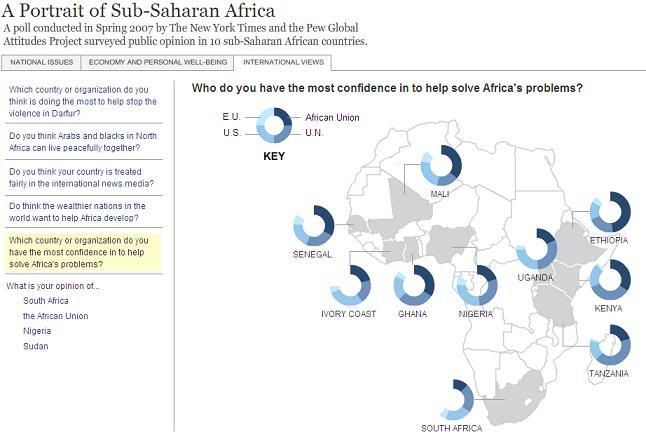
The Times has an interesting and interactive map (I'm a sucker for these) showing the results of a poll taken on attitudes in several sub-Saharan countries: Senegal, Mali, Uganda, Ivory Coast, Ghana, Nigeria, Ethiopia, Kenya, Tanzania and South Africa.

Some of the results are obvious, and others are not. The poll covers national issues, the economy and personal well-being, as well as international views. The most pressing national concerns seem to be "HIV/AIDS and other diseases," "corrupt political leaders," "crime" and "illegal drugs." Ethnic/religious conflict was seen as a problem by more than half of those polled in Kenya, Ivory Coast and Nigeria, with the latter polling particularly high.

Despite this, those polled seemed fairly optimistic, and those polled in every country overwhelmingly thought things would be better for their children than they have been for them.

Opinions vary pretty widely on the UN, US and AU, depending on the country, with Ethiopia unsurprisingly showing the most support for the AU, which is headquartered in Addis Ababa and the EU scoring particularly low overall for Africans' confidence that it can "help solve Africa's problems." 

In would have been interesting to have added more countries with one foot in "Arab Africa" and the other foot in "black Africa," particularly Sudan, Chad and Mauritania. Out of all the countries polled, the only two where the majority don't think that "Arabs and blacks in North Africa can live peacefully together" were Uganda and Tanzania.

Wednesday, June 20, 2007

The solution no one wants to see

Hamas has an op-ed in today's Times. That sounds funny, doesn't it? Haniya's political advisor, Ahmed Yousef, writes about how Hamas sees the lead up to the short civil war in Gaza:

Eighteen months ago, our Hamas Party won the Palestinian parliamentary elections and entered office under Prime Minister Ismail Haniya but never received the handover of real power from Fatah, the losing party. The Palestinian president, Mahmoud Abbas, has now tried to replace the winning Hamas government with one of his own, returning Fatah to power while many of our elected members of Parliament languish in Israeli jails. That is the real coup.

From the day Hamas won the general elections in 2006 it offered Fatah the chance of joining forces and forming a unity government. It tried to engage the international community to explain its platform for peace. It has consistently offered a 10-year cease-fire with the Israelis to try to create an atmosphere of calm in which we resolve our differences. Hamas even adhered to a unilateral cease-fire for 18 months in an effort to normalize the situation on the ground. None of these points appear to have been recognized in the press coverage of the last few days.

He then goes on to suggest that any "further attempts to marginalize us, starve our people into submission or attack us militarily will prove that the United States and Israeli governments are not genuinely interested in seeing an end to the violence." He's right, of course, in a certain sense.

Palestinians voted in what was seen as fair elections, and they chose Hamas. The West, and in particular the US, decided that they could not respect the results of a democratic election, schizophrenically withholding all aid from the new government. Israel, in its turn, withheld taxes garnished from Palestinians from their elected government. Fatah, sensing its newfound support from the US, Israel and the EU, refused to hand over security to the new government.

This created two "security forces," one with the legitimacy of democratic elections but wearing ski masks, the other with the trappings of an established Arab state but without the backing of popular elections. And therein lied the main security problem, which was only exacerbated by the West's refusal to give Hamas a chance to govern Palestine or prove that they were incapable of adapting to governance from resistance.

And so here we are now. People are already (and simplistically) splitting Palestine into Hamastan and Fatahland, with some even going so far as to make the argument that now is the time to join the West Bank in a federation with Jordan.

What would happen to Gaza? In most western views, there is an unspoken idea that while dealing with Fatah in the West Bank (the US has already resumed aid), Gaza will be starved into submission. Or maybe it will become a satellite of Egypt, where Mubarak would probably be all to willing to teach the Muslim Brotherhood a lesson in suffering by making an example out of Hamas. These are obviously not solutions, and whether we're talking about creating a Palestinian state in the West Bank and telling Hamas to drink the sea in Gaza or making a binational Jordanian-Palestinian state, the fact remains that this is a destruction of Palestinian self-determination and avowal of failure.

So what's the solution? I've said it before, but I'll say it again: one person, one vote, one state between the Mediterranean and the Jordan. But first things first: negotiations should immediately be set up for a unity government between Fatah and Hamas -- one in which a joint security force is created. The EU and US should agree to accept the results of Palestinian elections, ending a boycott of Hamas, provided that it sign a 10-year cease fire with Israel (which it has offered to do). It should also be pushed (with economic incentives) to start acting more like a government and less like a militia -- getting rid of the masks would be a good start. (Maybe having an op-ed in the Times is a good sign.) Let Fatah and being in control have a moderating effect on Hamas. And let Hamas start cleaning up some of Fatah's corruption and messy governance. In the meantime, Fatah should accept its role as the loyal opposition, redefining itself as a party whose fall from favor with the average Palestinian should be a stark wake up call for getting their act together. 

Steps should then be made to create a binational state of Israel/Palestine, one that has a constitution that guarantees equal rights to all citizens regardless of race or religion. Belgium should offer advice on the logistics of such a binational state. The right of return (for Jews suffering from anti-Semitism as well as all Palestinian refugees) will be the official immigration policy of the new state, which will have relinquished control of the Golan Heights and the Shebaa Farms in return for normalized relations with all Arab states. The borders will be opened, and my Israeli and Palestinian friends will be able to meet me in Tyre or Tel Aviv for a day at the beach.

That's the answer. Following the brief civil war in Gaza, people seem to be waking up to the idea that a two-state solution is a dead letter. Maybe it was possible twenty years ago, but given the "facts on the ground" created by the encroachment of illegal Jewish settlements, it no longer is. Israel's demographic nature, where 20 percent of all Israeli citizens are Palestinians, is another reason why the two-state solution can no longer exist: in 50 years, Israel will no longer have a Jewish majority, even if we disregard the occupied territories.

So almost everyone can agree that the two-state solution is dead, even if we can't agree who killed it (we all did). Almost no one, however, seems capable of making that extra jump in imagination necessary for realizing that a single state for Arabs and Jews is the only feasible and just solution.

Showing posts with label EU. Show all posts

Wednesday, December 19, 2007

Ceci n'est pas un pays

Roger Cohen has an interesting little piece on Belgium in the Times:

In their grumpy way, Belgians — a majority Dutch-speaking, many French-speaking and a few German-speaking — have been posing a delicate question: does postmodern Europe, where even tiny states feel secure, really need a medium-small nation cobbled together in 1830 whose various communities dislike one another?

Moreover, does a country whose economy is largely run by European central bankers in control of the euro really need a government?

Gerrit Six, a teacher, suggested Belgian obsolescence when he put the country, complete with its busy king and ballooning debt, up for sale on eBay. It drew bids of close to $15 million. That was on day 100 of the political crisis. Belgium is now close to day 200. Italian politics suddenly look stable.

Little Belgium has become too conflicted to rule. It has three regions, three language communities that are not congruent with the regions, a smattering of local parliaments, a mainly French-speaking capital (Brussels) lodged in Dutch-speaking Flanders, a strong current of Flemish nationalism and an uneasy history.

Dutch-speakers, long underdogs in a country without a Flemish university until 1922, are tired of subsidizing their now poorer French-speaking cousins. A successful anti-immigrant and separatist party, Vlaams Belang (Flemish Interest), is the odious expression of a wider desire to go it alone.

Flemish demands for greater decentralization and control (most recently over French-speaking schools in the Brussels periphery) have raised distrust to a poisonous level. “I am pretty sure Belgium will split eventually,” Caroline Sagesser, a political scientist, told me.

If it holds together, it will be because Brussels, with 10 percent of the population and 20 percent of gross domestic product, is too mixed to unravel. Like Baghdad, like Sarajevo, the capital is improbable but unyielding glue. Unlike them, it has avoided bloodshed. It also houses a modern marvel, the E.U. — and there’s the nub.

I often look at Lebanon and think, in the style of the Belgian surrealist: "this is not a country." Or state or nation, for that matter. Belgium has been without a government for almost 200 days, and Lebanon has been without a president since late last month. But who needs a government anyway?

Saturday, August 04, 2007

African Polls

The Times has an interesting and interactive map (I'm a sucker for these) showing the results of a poll taken on attitudes in several sub-Saharan countries: Senegal, Mali, Uganda, Ivory Coast, Ghana, Nigeria, Ethiopia, Kenya, Tanzania and South Africa.

Some of the results are obvious, and others are not. The poll covers national issues, the economy and personal well-being, as well as international views. The most pressing national concerns seem to be "HIV/AIDS and other diseases," "corrupt political leaders," "crime" and "illegal drugs." Ethnic/religious conflict was seen as a problem by more than half of those polled in Kenya, Ivory Coast and Nigeria, with the latter polling particularly high.

Despite this, those polled seemed fairly optimistic, and those polled in every country overwhelmingly thought things would be better for their children than they have been for them.

Opinions vary pretty widely on the UN, US and AU, depending on the country, with Ethiopia unsurprisingly showing the most support for the AU, which is headquartered in Addis Ababa and the EU scoring particularly low overall for Africans' confidence that it can "help solve Africa's problems." 

In would have been interesting to have added more countries with one foot in "Arab Africa" and the other foot in "black Africa," particularly Sudan, Chad and Mauritania. Out of all the countries polled, the only two where the majority don't think that "Arabs and blacks in North Africa can live peacefully together" were Uganda and Tanzania.

Wednesday, June 20, 2007

The solution no one wants to see

Hamas has an op-ed in today's Times. That sounds funny, doesn't it? Haniya's political advisor, Ahmed Yousef, writes about how Hamas sees the lead up to the short civil war in Gaza:

Eighteen months ago, our Hamas Party won the Palestinian parliamentary elections and entered office under Prime Minister Ismail Haniya but never received the handover of real power from Fatah, the losing party. The Palestinian president, Mahmoud Abbas, has now tried to replace the winning Hamas government with one of his own, returning Fatah to power while many of our elected members of Parliament languish in Israeli jails. That is the real coup.

From the day Hamas won the general elections in 2006 it offered Fatah the chance of joining forces and forming a unity government. It tried to engage the international community to explain its platform for peace. It has consistently offered a 10-year cease-fire with the Israelis to try to create an atmosphere of calm in which we resolve our differences. Hamas even adhered to a unilateral cease-fire for 18 months in an effort to normalize the situation on the ground. None of these points appear to have been recognized in the press coverage of the last few days.

He then goes on to suggest that any "further attempts to marginalize us, starve our people into submission or attack us militarily will prove that the United States and Israeli governments are not genuinely interested in seeing an end to the violence." He's right, of course, in a certain sense.

Palestinians voted in what was seen as fair elections, and they chose Hamas. The West, and in particular the US, decided that they could not respect the results of a democratic election, schizophrenically withholding all aid from the new government. Israel, in its turn, withheld taxes garnished from Palestinians from their elected government. Fatah, sensing its newfound support from the US, Israel and the EU, refused to hand over security to the new government.

This created two "security forces," one with the legitimacy of democratic elections but wearing ski masks, the other with the trappings of an established Arab state but without the backing of popular elections. And therein lied the main security problem, which was only exacerbated by the West's refusal to give Hamas a chance to govern Palestine or prove that they were incapable of adapting to governance from resistance.

And so here we are now. People are already (and simplistically) splitting Palestine into Hamastan and Fatahland, with some even going so far as to make the argument that now is the time to join the West Bank in a federation with Jordan.

What would happen to Gaza? In most western views, there is an unspoken idea that while dealing with Fatah in the West Bank (the US has already resumed aid), Gaza will be starved into submission. Or maybe it will become a satellite of Egypt, where Mubarak would probably be all to willing to teach the Muslim Brotherhood a lesson in suffering by making an example out of Hamas. These are obviously not solutions, and whether we're talking about creating a Palestinian state in the West Bank and telling Hamas to drink the sea in Gaza or making a binational Jordanian-Palestinian state, the fact remains that this is a destruction of Palestinian self-determination and avowal of failure.

So what's the solution? I've said it before, but I'll say it again: one person, one vote, one state between the Mediterranean and the Jordan. But first things first: negotiations should immediately be set up for a unity government between Fatah and Hamas -- one in which a joint security force is created. The EU and US should agree to accept the results of Palestinian elections, ending a boycott of Hamas, provided that it sign a 10-year cease fire with Israel (which it has offered to do). It should also be pushed (with economic incentives) to start acting more like a government and less like a militia -- getting rid of the masks would be a good start. (Maybe having an op-ed in the Times is a good sign.) Let Fatah and being in control have a moderating effect on Hamas. And let Hamas start cleaning up some of Fatah's corruption and messy governance. In the meantime, Fatah should accept its role as the loyal opposition, redefining itself as a party whose fall from favor with the average Palestinian should be a stark wake up call for getting their act together. 

Steps should then be made to create a binational state of Israel/Palestine, one that has a constitution that guarantees equal rights to all citizens regardless of race or religion. Belgium should offer advice on the logistics of such a binational state. The right of return (for Jews suffering from anti-Semitism as well as all Palestinian refugees) will be the official immigration policy of the new state, which will have relinquished control of the Golan Heights and the Shebaa Farms in return for normalized relations with all Arab states. The borders will be opened, and my Israeli and Palestinian friends will be able to meet me in Tyre or Tel Aviv for a day at the beach.

That's the answer. Following the brief civil war in Gaza, people seem to be waking up to the idea that a two-state solution is a dead letter. Maybe it was possible twenty years ago, but given the "facts on the ground" created by the encroachment of illegal Jewish settlements, it no longer is. Israel's demographic nature, where 20 percent of all Israeli citizens are Palestinians, is another reason why the two-state solution can no longer exist: in 50 years, Israel will no longer have a Jewish majority, even if we disregard the occupied territories.

So almost everyone can agree that the two-state solution is dead, even if we can't agree who killed it (we all did). Almost no one, however, seems capable of making that extra jump in imagination necessary for realizing that a single state for Arabs and Jews is the only feasible and just solution.
Showing posts with label EU. Show all posts

Wednesday, December 19, 2007

Ceci n'est pas un pays

Roger Cohen has an interesting little piece on Belgium in the Times:

In their grumpy way, Belgians — a majority Dutch-speaking, many French-speaking and a few German-speaking — have been posing a delicate question: does postmodern Europe, where even tiny states feel secure, really need a medium-small nation cobbled together in 1830 whose various communities dislike one another?

Moreover, does a country whose economy is largely run by European central bankers in control of the euro really need a government?

Gerrit Six, a teacher, suggested Belgian obsolescence when he put the country, complete with its busy king and ballooning debt, up for sale on eBay. It drew bids of close to $15 million. That was on day 100 of the political crisis. Belgium is now close to day 200. Italian politics suddenly look stable.

Little Belgium has become too conflicted to rule. It has three regions, three language communities that are not congruent with the regions, a smattering of local parliaments, a mainly French-speaking capital (Brussels) lodged in Dutch-speaking Flanders, a strong current of Flemish nationalism and an uneasy history.

Dutch-speakers, long underdogs in a country without a Flemish university until 1922, are tired of subsidizing their now poorer French-speaking cousins. A successful anti-immigrant and separatist party, Vlaams Belang (Flemish Interest), is the odious expression of a wider desire to go it alone.

Flemish demands for greater decentralization and control (most recently over French-speaking schools in the Brussels periphery) have raised distrust to a poisonous level. “I am pretty sure Belgium will split eventually,” Caroline Sagesser, a political scientist, told me.

If it holds together, it will be because Brussels, with 10 percent of the population and 20 percent of gross domestic product, is too mixed to unravel. Like Baghdad, like Sarajevo, the capital is improbable but unyielding glue. Unlike them, it has avoided bloodshed. It also houses a modern marvel, the E.U. — and there’s the nub.

I often look at Lebanon and think, in the style of the Belgian surrealist: "this is not a country." Or state or nation, for that matter. Belgium has been without a government for almost 200 days, and Lebanon has been without a president since late last month. But who needs a government anyway?

Saturday, August 04, 2007

African Polls

The Times has an interesting and interactive map (I'm a sucker for these) showing the results of a poll taken on attitudes in several sub-Saharan countries: Senegal, Mali, Uganda, Ivory Coast, Ghana, Nigeria, Ethiopia, Kenya, Tanzania and South Africa.

Some of the results are obvious, and others are not. The poll covers national issues, the economy and personal well-being, as well as international views. The most pressing national concerns seem to be "HIV/AIDS and other diseases," "corrupt political leaders," "crime" and "illegal drugs." Ethnic/religious conflict was seen as a problem by more than half of those polled in Kenya, Ivory Coast and Nigeria, with the latter polling particularly high.

Despite this, those polled seemed fairly optimistic, and those polled in every country overwhelmingly thought things would be better for their children than they have been for them.

Opinions vary pretty widely on the UN, US and AU, depending on the country, with Ethiopia unsurprisingly showing the most support for the AU, which is headquartered in Addis Ababa and the EU scoring particularly low overall for Africans' confidence that it can "help solve Africa's problems." 

In would have been interesting to have added more countries with one foot in "Arab Africa" and the other foot in "black Africa," particularly Sudan, Chad and Mauritania. Out of all the countries polled, the only two where the majority don't think that "Arabs and blacks in North Africa can live peacefully together" were Uganda and Tanzania.

Wednesday, June 20, 2007

The solution no one wants to see

Hamas has an op-ed in today's Times. That sounds funny, doesn't it? Haniya's political advisor, Ahmed Yousef, writes about how Hamas sees the lead up to the short civil war in Gaza:

Eighteen months ago, our Hamas Party won the Palestinian parliamentary elections and entered office under Prime Minister Ismail Haniya but never received the handover of real power from Fatah, the losing party. The Palestinian president, Mahmoud Abbas, has now tried to replace the winning Hamas government with one of his own, returning Fatah to power while many of our elected members of Parliament languish in Israeli jails. That is the real coup.

From the day Hamas won the general elections in 2006 it offered Fatah the chance of joining forces and forming a unity government. It tried to engage the international community to explain its platform for peace. It has consistently offered a 10-year cease-fire with the Israelis to try to create an atmosphere of calm in which we resolve our differences. Hamas even adhered to a unilateral cease-fire for 18 months in an effort to normalize the situation on the ground. None of these points appear to have been recognized in the press coverage of the last few days.

He then goes on to suggest that any "further attempts to marginalize us, starve our people into submission or attack us militarily will prove that the United States and Israeli governments are not genuinely interested in seeing an end to the violence." He's right, of course, in a certain sense.

Palestinians voted in what was seen as fair elections, and they chose Hamas. The West, and in particular the US, decided that they could not respect the results of a democratic election, schizophrenically withholding all aid from the new government. Israel, in its turn, withheld taxes garnished from Palestinians from their elected government. Fatah, sensing its newfound support from the US, Israel and the EU, refused to hand over security to the new government.

This created two "security forces," one with the legitimacy of democratic elections but wearing ski masks, the other with the trappings of an established Arab state but without the backing of popular elections. And therein lied the main security problem, which was only exacerbated by the West's refusal to give Hamas a chance to govern Palestine or prove that they were incapable of adapting to governance from resistance.

And so here we are now. People are already (and simplistically) splitting Palestine into Hamastan and Fatahland, with some even going so far as to make the argument that now is the time to join the West Bank in a federation with Jordan.

What would happen to Gaza? In most western views, there is an unspoken idea that while dealing with Fatah in the West Bank (the US has already resumed aid), Gaza will be starved into submission. Or maybe it will become a satellite of Egypt, where Mubarak would probably be all to willing to teach the Muslim Brotherhood a lesson in suffering by making an example out of Hamas. These are obviously not solutions, and whether we're talking about creating a Palestinian state in the West Bank and telling Hamas to drink the sea in Gaza or making a binational Jordanian-Palestinian state, the fact remains that this is a destruction of Palestinian self-determination and avowal of failure.

So what's the solution? I've said it before, but I'll say it again: one person, one vote, one state between the Mediterranean and the Jordan. But first things first: negotiations should immediately be set up for a unity government between Fatah and Hamas -- one in which a joint security force is created. The EU and US should agree to accept the results of Palestinian elections, ending a boycott of Hamas, provided that it sign a 10-year cease fire with Israel (which it has offered to do). It should also be pushed (with economic incentives) to start acting more like a government and less like a militia -- getting rid of the masks would be a good start. (Maybe having an op-ed in the Times is a good sign.) Let Fatah and being in control have a moderating effect on Hamas. And let Hamas start cleaning up some of Fatah's corruption and messy governance. In the meantime, Fatah should accept its role as the loyal opposition, redefining itself as a party whose fall from favor with the average Palestinian should be a stark wake up call for getting their act together. 

Steps should then be made to create a binational state of Israel/Palestine, one that has a constitution that guarantees equal rights to all citizens regardless of race or religion. Belgium should offer advice on the logistics of such a binational state. The right of return (for Jews suffering from anti-Semitism as well as all Palestinian refugees) will be the official immigration policy of the new state, which will have relinquished control of the Golan Heights and the Shebaa Farms in return for normalized relations with all Arab states. The borders will be opened, and my Israeli and Palestinian friends will be able to meet me in Tyre or Tel Aviv for a day at the beach.

That's the answer. Following the brief civil war in Gaza, people seem to be waking up to the idea that a two-state solution is a dead letter. Maybe it was possible twenty years ago, but given the "facts on the ground" created by the encroachment of illegal Jewish settlements, it no longer is. Israel's demographic nature, where 20 percent of all Israeli citizens are Palestinians, is another reason why the two-state solution can no longer exist: in 50 years, Israel will no longer have a Jewish majority, even if we disregard the occupied territories.

So almost everyone can agree that the two-state solution is dead, even if we can't agree who killed it (we all did). Almost no one, however, seems capable of making that extra jump in imagination necessary for realizing that a single state for Arabs and Jews is the only feasible and just solution.

Showing posts with label EU. Show all posts

Wednesday, December 19, 2007

Ceci n'est pas un pays

Roger Cohen has an interesting little piece on Belgium in the Times:

In their grumpy way, Belgians — a majority Dutch-speaking, many French-speaking and a few German-speaking — have been posing a delicate question: does postmodern Europe, where even tiny states feel secure, really need a medium-small nation cobbled together in 1830 whose various communities dislike one another?

Moreover, does a country whose economy is largely run by European central bankers in control of the euro really need a government?

Gerrit Six, a teacher, suggested Belgian obsolescence when he put the country, complete with its busy king and ballooning debt, up for sale on eBay. It drew bids of close to $15 million. That was on day 100 of the political crisis. Belgium is now close to day 200. Italian politics suddenly look stable.

Little Belgium has become too conflicted to rule. It has three regions, three language communities that are not congruent with the regions, a smattering of local parliaments, a mainly French-speaking capital (Brussels) lodged in Dutch-speaking Flanders, a strong current of Flemish nationalism and an uneasy history.

Dutch-speakers, long underdogs in a country without a Flemish university until 1922, are tired of subsidizing their now poorer French-speaking cousins. A successful anti-immigrant and separatist party, Vlaams Belang (Flemish Interest), is the odious expression of a wider desire to go it alone.

Flemish demands for greater decentralization and control (most recently over French-speaking schools in the Brussels periphery) have raised distrust to a poisonous level. “I am pretty sure Belgium will split eventually,” Caroline Sagesser, a political scientist, told me.

If it holds together, it will be because Brussels, with 10 percent of the population and 20 percent of gross domestic product, is too mixed to unravel. Like Baghdad, like Sarajevo, the capital is improbable but unyielding glue. Unlike them, it has avoided bloodshed. It also houses a modern marvel, the E.U. — and there’s the nub.

I often look at Lebanon and think, in the style of the Belgian surrealist: "this is not a country." Or state or nation, for that matter. Belgium has been without a government for almost 200 days, and Lebanon has been without a president since late last month. But who needs a government anyway?

Saturday, August 04, 2007

African Polls

The Times has an interesting and interactive map (I'm a sucker for these) showing the results of a poll taken on attitudes in several sub-Saharan countries: Senegal, Mali, Uganda, Ivory Coast, Ghana, Nigeria, Ethiopia, Kenya, Tanzania and South Africa.

Some of the results are obvious, and others are not. The poll covers national issues, the economy and personal well-being, as well as international views. The most pressing national concerns seem to be "HIV/AIDS and other diseases," "corrupt political leaders," "crime" and "illegal drugs." Ethnic/religious conflict was seen as a problem by more than half of those polled in Kenya, Ivory Coast and Nigeria, with the latter polling particularly high.

Despite this, those polled seemed fairly optimistic, and those polled in every country overwhelmingly thought things would be better for their children than they have been for them.

Opinions vary pretty widely on the UN, US and AU, depending on the country, with Ethiopia unsurprisingly showing the most support for the AU, which is headquartered in Addis Ababa and the EU scoring particularly low overall for Africans' confidence that it can "help solve Africa's problems." 

In would have been interesting to have added more countries with one foot in "Arab Africa" and the other foot in "black Africa," particularly Sudan, Chad and Mauritania. Out of all the countries polled, the only two where the majority don't think that "Arabs and blacks in North Africa can live peacefully together" were Uganda and Tanzania.

Wednesday, June 20, 2007

The solution no one wants to see

Hamas has an op-ed in today's Times. That sounds funny, doesn't it? Haniya's political advisor, Ahmed Yousef, writes about how Hamas sees the lead up to the short civil war in Gaza:

Eighteen months ago, our Hamas Party won the Palestinian parliamentary elections and entered office under Prime Minister Ismail Haniya but never received the handover of real power from Fatah, the losing party. The Palestinian president, Mahmoud Abbas, has now tried to replace the winning Hamas government with one of his own, returning Fatah to power while many of our elected members of Parliament languish in Israeli jails. That is the real coup.

From the day Hamas won the general elections in 2006 it offered Fatah the chance of joining forces and forming a unity government. It tried to engage the international community to explain its platform for peace. It has consistently offered a 10-year cease-fire with the Israelis to try to create an atmosphere of calm in which we resolve our differences. Hamas even adhered to a unilateral cease-fire for 18 months in an effort to normalize the situation on the ground. None of these points appear to have been recognized in the press coverage of the last few days.

He then goes on to suggest that any "further attempts to marginalize us, starve our people into submission or attack us militarily will prove that the United States and Israeli governments are not genuinely interested in seeing an end to the violence." He's right, of course, in a certain sense.

Palestinians voted in what was seen as fair elections, and they chose Hamas. The West, and in particular the US, decided that they could not respect the results of a democratic election, schizophrenically withholding all aid from the new government. Israel, in its turn, withheld taxes garnished from Palestinians from their elected government. Fatah, sensing its newfound support from the US, Israel and the EU, refused to hand over security to the new government.

This created two "security forces," one with the legitimacy of democratic elections but wearing ski masks, the other with the trappings of an established Arab state but without the backing of popular elections. And therein lied the main security problem, which was only exacerbated by the West's refusal to give Hamas a chance to govern Palestine or prove that they were incapable of adapting to governance from resistance.

And so here we are now. People are already (and simplistically) splitting Palestine into Hamastan and Fatahland, with some even going so far as to make the argument that now is the time to join the West Bank in a federation with Jordan.

What would happen to Gaza? In most western views, there is an unspoken idea that while dealing with Fatah in the West Bank (the US has already resumed aid), Gaza will be starved into submission. Or maybe it will become a satellite of Egypt, where Mubarak would probably be all to willing to teach the Muslim Brotherhood a lesson in suffering by making an example out of Hamas. These are obviously not solutions, and whether we're talking about creating a Palestinian state in the West Bank and telling Hamas to drink the sea in Gaza or making a binational Jordanian-Palestinian state, the fact remains that this is a destruction of Palestinian self-determination and avowal of failure.

So what's the solution? I've said it before, but I'll say it again: one person, one vote, one state between the Mediterranean and the Jordan. But first things first: negotiations should immediately be set up for a unity government between Fatah and Hamas -- one in which a joint security force is created. The EU and US should agree to accept the results of Palestinian elections, ending a boycott of Hamas, provided that it sign a 10-year cease fire with Israel (which it has offered to do). It should also be pushed (with economic incentives) to start acting more like a government and less like a militia -- getting rid of the masks would be a good start. (Maybe having an op-ed in the Times is a good sign.) Let Fatah and being in control have a moderating effect on Hamas. And let Hamas start cleaning up some of Fatah's corruption and messy governance. In the meantime, Fatah should accept its role as the loyal opposition, redefining itself as a party whose fall from favor with the average Palestinian should be a stark wake up call for getting their act together. 

Steps should then be made to create a binational state of Israel/Palestine, one that has a constitution that guarantees equal rights to all citizens regardless of race or religion. Belgium should offer advice on the logistics of such a binational state. The right of return (for Jews suffering from anti-Semitism as well as all Palestinian refugees) will be the official immigration policy of the new state, which will have relinquished control of the Golan Heights and the Shebaa Farms in return for normalized relations with all Arab states. The borders will be opened, and my Israeli and Palestinian friends will be able to meet me in Tyre or Tel Aviv for a day at the beach.

That's the answer. Following the brief civil war in Gaza, people seem to be waking up to the idea that a two-state solution is a dead letter. Maybe it was possible twenty years ago, but given the "facts on the ground" created by the encroachment of illegal Jewish settlements, it no longer is. Israel's demographic nature, where 20 percent of all Israeli citizens are Palestinians, is another reason why the two-state solution can no longer exist: in 50 years, Israel will no longer have a Jewish majority, even if we disregard the occupied territories.

So almost everyone can agree that the two-state solution is dead, even if we can't agree who killed it (we all did). Almost no one, however, seems capable of making that extra jump in imagination necessary for realizing that a single state for Arabs and Jews is the only feasible and just solution.

Showing posts with label EU. Show all posts

Wednesday, December 19, 2007

Ceci n'est pas un pays

Roger Cohen has an interesting little piece on Belgium in the Times:

In their grumpy way, Belgians — a majority Dutch-speaking, many French-speaking and a few German-speaking — have been posing a delicate question: does postmodern Europe, where even tiny states feel secure, really need a medium-small nation cobbled together in 1830 whose various communities dislike one another?

Moreover, does a country whose economy is largely run by European central bankers in control of the euro really need a government?

Gerrit Six, a teacher, suggested Belgian obsolescence when he put the country, complete with its busy king and ballooning debt, up for sale on eBay. It drew bids of close to $15 million. That was on day 100 of the political crisis. Belgium is now close to day 200. Italian politics suddenly look stable.

Little Belgium has become too conflicted to rule. It has three regions, three language communities that are not congruent with the regions, a smattering of local parliaments, a mainly French-speaking capital (Brussels) lodged in Dutch-speaking Flanders, a strong current of Flemish nationalism and an uneasy history.

Dutch-speakers, long underdogs in a country without a Flemish university until 1922, are tired of subsidizing their now poorer French-speaking cousins. A successful anti-immigrant and separatist party, Vlaams Belang (Flemish Interest), is the odious expression of a wider desire to go it alone.

Flemish demands for greater decentralization and control (most recently over French-speaking schools in the Brussels periphery) have raised distrust to a poisonous level. “I am pretty sure Belgium will split eventually,” Caroline Sagesser, a political scientist, told me.

If it holds together, it will be because Brussels, with 10 percent of the population and 20 percent of gross domestic product, is too mixed to unravel. Like Baghdad, like Sarajevo, the capital is improbable but unyielding glue. Unlike them, it has avoided bloodshed. It also houses a modern marvel, the E.U. — and there’s the nub.

I often look at Lebanon and think, in the style of the Belgian surrealist: "this is not a country." Or state or nation, for that matter. Belgium has been without a government for almost 200 days, and Lebanon has been without a president since late last month. But who needs a government anyway?

Saturday, August 04, 2007

African Polls

The Times has an interesting and interactive map (I'm a sucker for these) showing the results of a poll taken on attitudes in several sub-Saharan countries: Senegal, Mali, Uganda, Ivory Coast, Ghana, Nigeria, Ethiopia, Kenya, Tanzania and South Africa.

Some of the results are obvious, and others are not. The poll covers national issues, the economy and personal well-being, as well as international views. The most pressing national concerns seem to be "HIV/AIDS and other diseases," "corrupt political leaders," "crime" and "illegal drugs." Ethnic/religious conflict was seen as a problem by more than half of those polled in Kenya, Ivory Coast and Nigeria, with the latter polling particularly high.

Despite this, those polled seemed fairly optimistic, and those polled in every country overwhelmingly thought things would be better for their children than they have been for them.

Opinions vary pretty widely on the UN, US and AU, depending on the country, with Ethiopia unsurprisingly showing the most support for the AU, which is headquartered in Addis Ababa and the EU scoring particularly low overall for Africans' confidence that it can "help solve Africa's problems." 

In would have been interesting to have added more countries with one foot in "Arab Africa" and the other foot in "black Africa," particularly Sudan, Chad and Mauritania. Out of all the countries polled, the only two where the majority don't think that "Arabs and blacks in North Africa can live peacefully together" were Uganda and Tanzania.

Wednesday, June 20, 2007

The solution no one wants to see

Hamas has an op-ed in today's Times. That sounds funny, doesn't it? Haniya's political advisor, Ahmed Yousef, writes about how Hamas sees the lead up to the short civil war in Gaza:

Eighteen months ago, our Hamas Party won the Palestinian parliamentary elections and entered office under Prime Minister Ismail Haniya but never received the handover of real power from Fatah, the losing party. The Palestinian president, Mahmoud Abbas, has now tried to replace the winning Hamas government with one of his own, returning Fatah to power while many of our elected members of Parliament languish in Israeli jails. That is the real coup.

From the day Hamas won the general elections in 2006 it offered Fatah the chance of joining forces and forming a unity government. It tried to engage the international community to explain its platform for peace. It has consistently offered a 10-year cease-fire with the Israelis to try to create an atmosphere of calm in which we resolve our differences. Hamas even adhered to a unilateral cease-fire for 18 months in an effort to normalize the situation on the ground. None of these points appear to have been recognized in the press coverage of the last few days.

He then goes on to suggest that any "further attempts to marginalize us, starve our people into submission or attack us militarily will prove that the United States and Israeli governments are not genuinely interested in seeing an end to the violence." He's right, of course, in a certain sense.

Palestinians voted in what was seen as fair elections, and they chose Hamas. The West, and in particular the US, decided that they could not respect the results of a democratic election, schizophrenically withholding all aid from the new government. Israel, in its turn, withheld taxes garnished from Palestinians from their elected government. Fatah, sensing its newfound support from the US, Israel and the EU, refused to hand over security to the new government.

This created two "security forces," one with the legitimacy of democratic elections but wearing ski masks, the other with the trappings of an established Arab state but without the backing of popular elections. And therein lied the main security problem, which was only exacerbated by the West's refusal to give Hamas a chance to govern Palestine or prove that they were incapable of adapting to governance from resistance.

And so here we are now. People are already (and simplistically) splitting Palestine into Hamastan and Fatahland, with some even going so far as to make the argument that now is the time to join the West Bank in a federation with Jordan.

What would happen to Gaza? In most western views, there is an unspoken idea that while dealing with Fatah in the West Bank (the US has already resumed aid), Gaza will be starved into submission. Or maybe it will become a satellite of Egypt, where Mubarak would probably be all to willing to teach the Muslim Brotherhood a lesson in suffering by making an example out of Hamas. These are obviously not solutions, and whether we're talking about creating a Palestinian state in the West Bank and telling Hamas to drink the sea in Gaza or making a binational Jordanian-Palestinian state, the fact remains that this is a destruction of Palestinian self-determination and avowal of failure.

So what's the solution? I've said it before, but I'll say it again: one person, one vote, one state between the Mediterranean and the Jordan. But first things first: negotiations should immediately be set up for a unity government between Fatah and Hamas -- one in which a joint security force is created. The EU and US should agree to accept the results of Palestinian elections, ending a boycott of Hamas, provided that it sign a 10-year cease fire with Israel (which it has offered to do). It should also be pushed (with economic incentives) to start acting more like a government and less like a militia -- getting rid of the masks would be a good start. (Maybe having an op-ed in the Times is a good sign.) Let Fatah and being in control have a moderating effect on Hamas. And let Hamas start cleaning up some of Fatah's corruption and messy governance. In the meantime, Fatah should accept its role as the loyal opposition, redefining itself as a party whose fall from favor with the average Palestinian should be a stark wake up call for getting their act together. 

Steps should then be made to create a binational state of Israel/Palestine, one that has a constitution that guarantees equal rights to all citizens regardless of race or religion. Belgium should offer advice on the logistics of such a binational state. The right of return (for Jews suffering from anti-Semitism as well as all Palestinian refugees) will be the official immigration policy of the new state, which will have relinquished control of the Golan Heights and the Shebaa Farms in return for normalized relations with all Arab states. The borders will be opened, and my Israeli and Palestinian friends will be able to meet me in Tyre or Tel Aviv for a day at the beach.

That's the answer. Following the brief civil war in Gaza, people seem to be waking up to the idea that a two-state solution is a dead letter. Maybe it was possible twenty years ago, but given the "facts on the ground" created by the encroachment of illegal Jewish settlements, it no longer is. Israel's demographic nature, where 20 percent of all Israeli citizens are Palestinians, is another reason why the two-state solution can no longer exist: in 50 years, Israel will no longer have a Jewish majority, even if we disregard the occupied territories.

So almost everyone can agree that the two-state solution is dead, even if we can't agree who killed it (we all did). Almost no one, however, seems capable of making that extra jump in imagination necessary for realizing that a single state for Arabs and Jews is the only feasible and just solution.

Showing posts with label EU. Show all posts

Wednesday, December 19, 2007

Ceci n'est pas un pays

Roger Cohen has an interesting little piece on Belgium in the Times:

In their grumpy way, Belgians — a majority Dutch-speaking, many French-speaking and a few German-speaking — have been posing a delicate question: does postmodern Europe, where even tiny states feel secure, really need a medium-small nation cobbled together in 1830 whose various communities dislike one another?

Moreover, does a country whose economy is largely run by European central bankers in control of the euro really need a government?

Gerrit Six, a teacher, suggested Belgian obsolescence when he put the country, complete with its busy king and ballooning debt, up for sale on eBay. It drew bids of close to $15 million. That was on day 100 of the political crisis. Belgium is now close to day 200. Italian politics suddenly look stable.

Little Belgium has become too conflicted to rule. It has three regions, three language communities that are not congruent with the regions, a smattering of local parliaments, a mainly French-speaking capital (Brussels) lodged in Dutch-speaking Flanders, a strong current of Flemish nationalism and an uneasy history.

Dutch-speakers, long underdogs in a country without a Flemish university until 1922, are tired of subsidizing their now poorer French-speaking cousins. A successful anti-immigrant and separatist party, Vlaams Belang (Flemish Interest), is the odious expression of a wider desire to go it alone.

Flemish demands for greater decentralization and control (most recently over French-speaking schools in the Brussels periphery) have raised distrust to a poisonous level. “I am pretty sure Belgium will split eventually,” Caroline Sagesser, a political scientist, told me.

If it holds together, it will be because Brussels, with 10 percent of the population and 20 percent of gross domestic product, is too mixed to unravel. Like Baghdad, like Sarajevo, the capital is improbable but unyielding glue. Unlike them, it has avoided bloodshed. It also houses a modern marvel, the E.U. — and there’s the nub.

I often look at Lebanon and think, in the style of the Belgian surrealist: "this is not a country." Or state or nation, for that matter. Belgium has been without a government for almost 200 days, and Lebanon has been without a president since late last month. But who needs a government anyway?

Saturday, August 04, 2007

African Polls

The Times has an interesting and interactive map (I'm a sucker for these) showing the results of a poll taken on attitudes in several sub-Saharan countries: Senegal, Mali, Uganda, Ivory Coast, Ghana, Nigeria, Ethiopia, Kenya, Tanzania and South Africa.

Some of the results are obvious, and others are not. The poll covers national issues, the economy and personal well-being, as well as international views. The most pressing national concerns seem to be "HIV/AIDS and other diseases," "corrupt political leaders," "crime" and "illegal drugs." Ethnic/religious conflict was seen as a problem by more than half of those polled in Kenya, Ivory Coast and Nigeria, with the latter polling particularly high.

Despite this, those polled seemed fairly optimistic, and those polled in every country overwhelmingly thought things would be better for their children than they have been for them.

Opinions vary pretty widely on the UN, US and AU, depending on the country, with Ethiopia unsurprisingly showing the most support for the AU, which is headquartered in Addis Ababa and the EU scoring particularly low overall for Africans' confidence that it can "help solve Africa's problems." 

In would have been interesting to have added more countries with one foot in "Arab Africa" and the other foot in "black Africa," particularly Sudan, Chad and Mauritania. Out of all the countries polled, the only two where the majority don't think that "Arabs and blacks in North Africa can live peacefully together" were Uganda and Tanzania.

Wednesday, June 20, 2007

The solution no one wants to see

Hamas has an op-ed in today's Times. That sounds funny, doesn't it? Haniya's political advisor, Ahmed Yousef, writes about how Hamas sees the lead up to the short civil war in Gaza:

Eighteen months ago, our Hamas Party won the Palestinian parliamentary elections and entered office under Prime Minister Ismail Haniya but never received the handover of real power from Fatah, the losing party. The Palestinian president, Mahmoud Abbas, has now tried to replace the winning Hamas government with one of his own, returning Fatah to power while many of our elected members of Parliament languish in Israeli jails. That is the real coup.

From the day Hamas won the general elections in 2006 it offered Fatah the chance of joining forces and forming a unity government. It tried to engage the international community to explain its platform for peace. It has consistently offered a 10-year cease-fire with the Israelis to try to create an atmosphere of calm in which we resolve our differences. Hamas even adhered to a unilateral cease-fire for 18 months in an effort to normalize the situation on the ground. None of these points appear to have been recognized in the press coverage of the last few days.

He then goes on to suggest that any "further attempts to marginalize us, starve our people into submission or attack us militarily will prove that the United States and Israeli governments are not genuinely interested in seeing an end to the violence." He's right, of course, in a certain sense.

Palestinians voted in what was seen as fair elections, and they chose Hamas. The West, and in particular the US, decided that they could not respect the results of a democratic election, schizophrenically withholding all aid from the new government. Israel, in its turn, withheld taxes garnished from Palestinians from their elected government. Fatah, sensing its newfound support from the US, Israel and the EU, refused to hand over security to the new government.

This created two "security forces," one with the legitimacy of democratic elections but wearing ski masks, the other with the trappings of an established Arab state but without the backing of popular elections. And therein lied the main security problem, which was only exacerbated by the West's refusal to give Hamas a chance to govern Palestine or prove that they were incapable of adapting to governance from resistance.

And so here we are now. People are already (and simplistically) splitting Palestine into Hamastan and Fatahland, with some even going so far as to make the argument that now is the time to join the West Bank in a federation with Jordan.

What would happen to Gaza? In most western views, there is an unspoken idea that while dealing with Fatah in the West Bank (the US has already resumed aid), Gaza will be starved into submission. Or maybe it will become a satellite of Egypt, where Mubarak would probably be all to willing to teach the Muslim Brotherhood a lesson in suffering by making an example out of Hamas. These are obviously not solutions, and whether we're talking about creating a Palestinian state in the West Bank and telling Hamas to drink the sea in Gaza or making a binational Jordanian-Palestinian state, the fact remains that this is a destruction of Palestinian self-determination and avowal of failure.

So what's the solution? I've said it before, but I'll say it again: one person, one vote, one state between the Mediterranean and the Jordan. But first things first: negotiations should immediately be set up for a unity government between Fatah and Hamas -- one in which a joint security force is created. The EU and US should agree to accept the results of Palestinian elections, ending a boycott of Hamas, provided that it sign a 10-year cease fire with Israel (which it has offered to do). It should also be pushed (with economic incentives) to start acting more like a government and less like a militia -- getting rid of the masks would be a good start. (Maybe having an op-ed in the Times is a good sign.) Let Fatah and being in control have a moderating effect on Hamas. And let Hamas start cleaning up some of Fatah's corruption and messy governance. In the meantime, Fatah should accept its role as the loyal opposition, redefining itself as a party whose fall from favor with the average Palestinian should be a stark wake up call for getting their act together. 

Steps should then be made to create a binational state of Israel/Palestine, one that has a constitution that guarantees equal rights to all citizens regardless of race or religion. Belgium should offer advice on the logistics of such a binational state. The right of return (for Jews suffering from anti-Semitism as well as all Palestinian refugees) will be the official immigration policy of the new state, which will have relinquished control of the Golan Heights and the Shebaa Farms in return for normalized relations with all Arab states. The borders will be opened, and my Israeli and Palestinian friends will be able to meet me in Tyre or Tel Aviv for a day at the beach.

That's the answer. Following the brief civil war in Gaza, people seem to be waking up to the idea that a two-state solution is a dead letter. Maybe it was possible twenty years ago, but given the "facts on the ground" created by the encroachment of illegal Jewish settlements, it no longer is. Israel's demographic nature, where 20 percent of all Israeli citizens are Palestinians, is another reason why the two-state solution can no longer exist: in 50 years, Israel will no longer have a Jewish majority, even if we disregard the occupied territories.

So almost everyone can agree that the two-state solution is dead, even if we can't agree who killed it (we all did). Almost no one, however, seems capable of making that extra jump in imagination necessary for realizing that a single state for Arabs and Jews is the only feasible and just solution.