Wednesday, December 20, 2006
Break...
I'm off to al-Andalus until the new year, so I doubt that I'll be posting...
Happy holidays.

Setting Lebanon Free
I meant to mention this the other day, but it slipped my mind. Robert Grenier, former director of the CIA's counterintelligence center, thinks that if the US loves Lebanon, we should set it free.
ONCE more, Lebanon is in political crisis. This time, we are told, it pits "Syrian- and Iranian-backed" Shiite parties (Hezbollah and Amal) and the Christian faction led by Michel Aoun against the "Western-backed" Christian, Sunni and Druze groups that support the government of Prime Minister Fouad Siniora.
These very descriptions -- citing one external backer or another as a mark of political identification -- illustrate the fundamental problem Lebanon must overcome. Call it the Lebanese Disease: rather than sorting out their differences internally and addressing the fundamental injustices at the heart of their disputes, the Lebanese constantly look to outsiders to gain an advantage over their rivals.
Naturally, any advantages thus gained are short-lived, for both the Lebanese and their foreign backers. In the end, the only result is greater popular suffering and instability in Lebanon and the entire Middle East.
Only the Lebanese can cure themselves of this disease, but a bit of enlightened self-interest on the part of the "Western backers" -- primarily the United States and France ? would greatly help. It may seem counterintuitive, but the best hope for American interests in the Middle East is not to isolate and minimize Hezbollah, but to further integrate it politically, socially and militarily into the Lebanese state.
...It has long been obvious that the Shiites are under-represented in Lebanon's complicated power-sharing arrangements. In return for a greater measure of political representation for Shiites, Mr. Siniora could have insisted that Hezbollah's militia be brought under some sort of state control -- perhaps as a sort of home guard for the south, with its fighters under the command of senior officers drawn from the Lebanese armed forces.
...A far more genuine American commitment to Lebanon would focus on helping the parties to come up with a reasonable formula to redress the under-representation of Shiites in the power structure while getting greater government control over Hezbollah's war-making capacity.
Tuesday, December 19, 2006
Shouting across the divide
This American Life has an excellent piece on bridging the gap between Muslims and non-Muslims. The segment is about the statue of Mohammad in the Supreme Court, a Muslim-American family whose life is wrecked by a evangelizing fourth grade teacher, and an ad exec who tries to sell brand America. You can listen to the show or download it as an mp3 until later this week.
In the first story, the representative of CAIR tries to explain why Muslims don't appreciate the statue of Mohammad, even if it is supposed to be inclusive. In the second, a fourth-grade teacher reads her students a book on how Muslims hate America and Christians for the anniversary of 9/11 then explains to the only Muslim child how she and her family will go to hell if they don't accept the blood of Jesus. Finally, the third segment shows the difficulty of using the same formula to sell Coke to sell America might not work and explores a possible slogan about Muslim control of Islam's holy cities Mecca, Medina and Jerusalem: "Two outta three ain't bad!"
Monday, December 18, 2006
Petrodollars to petro-euros
Tehran has just announced that Iran will be converting all of its assets, holdings, reserves and accounting from US dollars to euros.
I remember there being talk during the run-up to the war in Iraq that one of the reasons for the invasion of Iraq was to reverse Saddam's decision to dump the dollar for the Euro. Whether or not Baghdad's decision to trade in euros, which incidentally made Iraq a lot of money, had anything to do with the invasion is unclear. To be honest, I don't understand enough about monetary policy to know exactly how OPEC countries' changing to Euros would affect the US economy, except for a vague sense that the results would be less than positive for America. I would, however, be willing to bet that Iraq now only trades in US dollars.
We'll see what effect Iran's decision will have, but if I had to guess, I'd say that it hasn't helped relations between Washington and Tehran.
Sunday, December 17, 2006
On civil war in Iraq
Safire is debating the usage "civil war" in describing Iraq. Personally, I took to calling a spade a spade almost a year and a half ago.
Safire makes a point of boasting about his easy access to president Talibani, who "definitively" does not call it a civil war, and he quotes Bill Keller, the executive editor of the Times who makes the following point:
I bristle at the way a low-grade semantic argument has become -- at least among the partisan cud-chewers -- a substitute for serious discussion of what's happening in Iraq and what to do about it. ... Maybe this argument is a symptom of intellectual fatigue in the punditocracy.
So while I can agree that a lot of people are arguing about what to call it while not thinking enough about what to do there, I don't agree with Safire, who in the end, thinks that it's just a value judgement:
Call the fighting what you like, but the name you choose to give the hostilities, strife, violence or war not only reflects your view about the current state of affairs but is also an indication of where you stand on what our policy should be. Labels are the language's shorthand for judgments.
I disagree. Words have meaning. So although it's true that certain people push for the civil war in Iraq to be called one thing or another for ideological reasons, that does not mean that one label is more or less accurate than another. And when Safire's Kurdish friend argues that
There is a more complex dynamic to this than civil war... There is Shia versus Shia, Sunni versus Sunni, Shia versus Sunni and Shia and Sunni versus Al Qaeda, as well as militias against the authority of the elected government. Many act as the proxies of regional powers, so you can call it as much a proxy war as a civil war.
I have a hard time thinking that he's being anything but disingenuous, since, if anything, the Lebanese civil war was even more complex. There, we saw 18 confessional groups lining up with over half a dozen foreign powers (Israel, Syria, Iraq, US, France, Italy, etc.) and the Palestinians, who were somewhat in between a domestic and a foreign force. Does anyone call that anything other than a civil war? So why should Iraq be any different?
Sunday, December 10, 2006
Underqualified
I read this IHT Op-Ed by Jeff Stein last October with a mixture of sad resignation and sighing wonderment, thinking to myself that it's no wonder American foreign policy in the Middle East is so often so wrongheaded and obviously stupid. After all, if US counterterrorism officials and congressmen don't know answers to such basic questions as the difference between Sunni and Shi'a Muslims, or even to which sects Al-Qaeda, Iran and Hezbollah belong, how can they make informed decisions about issues that are based on underlying differences between the region's actors?
So I have to say that while I'm not surprised, I am certainly disappointed to see that the newly appointed Democratic intelligence chairman is equally uninformed (via Ezra):
...like a number of his colleagues and top counterterrorism officials that I've interviewed over the past several months, Reyes can't answer some fundamental questions about the powerful forces arrayed against us in the Middle East.
It begs the question, of course: How can the Intelligence Committee do effective oversight of U.S. spy agencies when its leaders don't know basics about the battlefield?
...Reyes stumbled when I asked him a simple question about al Qaeda at the end of a 40-minute interview in his office last week. Members of the Intelligence Committee, mind you, are paid $165,200 a year to know more than basic facts about our foes in the Middle East.
We warmed up with a long discussion about intelligence issues and Iraq. And then we veered into terrorism's major players.
To me, it's like asking about Catholics and Protestants in Northern Ireland: Who's on what side?
The dialogue went like this:
Al Qaeda is what, I asked, Sunni or Shia?
"Al Qaeda, they have both," Reyes said. "You're talking about predominately?"
"Sure," I said, not knowing what else to say.
"Predominantly -- probably Shiite," he ventured.
...And Hezbollah? I asked him. What are they?
"Hezbollah. Uh, Hezbollah..."
He laughed again, shifting in his seat.
"Why do you ask me these questions at five o'clock? Can I answer in Spanish? Do you speak Spanish?"
"Pocito," I said -- a little.
"Pocito?!" He laughed again.
"Go ahead," I said, talk to me about Sunnis and Shia in Spanish.
Reyes: "Well, I, uh...."
Stein goes on to tell us how the woeful ignorance of the region goes all the way from the top of the chain of command to those on the ground -- the employees of the embassy in Baghdad. It seems that of all the Americans at the embassy in Iraq, there are only six fluent Arabic speakers and two dozen who have some familiarity with the language. This is out of over a thousand employees.
There is definitely a dearth of specialists of the region and speakers of its languages. And those in charge don't seem very concerned about it, since according to the Department of Defense, between 1993 and 2003, 55 Arabic speakers and 9 Farsi speakers have been fired in accordance with the US military's policy of "Don't ask, Don't tell."
The 9/11 commission report decried the lack of Arabic speakers, a situation that has led to a huge backlog of untranslated documents in the government's counterterrorism efforts. It seems not only disheartening but disconcerting that ideological issues such as one's sexual orientation would trump national security concerns.
So while I'm glad to see that some of those who pushed the most ferociously for war in Iraq will no longer be in a position to decide foreign policy in the region, I'm afraid that their Democratic counterparts aren't any more qualified to make such important decisions.
Friday, December 08, 2006
Peace not apartheid in Palestine
Jimmy Carter, responding to the reaction his new book has received, has a sincere and thoughtful piece in the LA Times on speaking frankly about Israel and Palestine:
The many controversial issues concerning Palestine and the path to peace for Israel are intensely debated among Israelis and throughout other nations ? but not in the United States. For the last 30 years, I have witnessed and experienced the severe restraints on any free and balanced discussion of the facts. This reluctance to criticize any policies of the Israeli government is because of the extraordinary lobbying efforts of the American-Israel Political Action Committee and the absence of any significant contrary voices.
It would be almost politically suicidal for members of Congress to espouse a balanced position between Israel and Palestine, to suggest that Israel comply with international law or to speak in defense of justice or human rights for Palestinians. Very few would ever deign to visit the Palestinian cities of Ramallah, Nablus, Hebron, Gaza City or even Bethlehem and talk to the beleaguered residents. What is even more difficult to comprehend is why the editorial pages of the major newspapers and magazines in the United States exercise similar self-restraint, quite contrary to private assessments expressed quite forcefully by their correspondents in the Holy Land.
While I disagree with Carter on the idea of a two-state solution (I believe the only tenable solution to the conflict is a single democratic state where one person has one vote), I agree wholeheartedly with the problems that arise in the US when one wants to have an honest discussion about Israel/Palestine.
Proving his point, we can see that this is the kind of reaction that genuine discourse, such as Carter's gets in the US. Of course this elder statesman handles himself with propriety and grace, neither of which such mean-spirited and asinine attacks really warrant.
Tuesday, December 05, 2006
The Pulitzer and an Iranian execution
The Wall Street Journal has an excellent piece on photographs of executed Kurds during the Iranian revolution and the photographer who until now has remained anonymous.


Sunday, December 03, 2006
One reported dead in street violence in Beirut
According to Lebanese television, a group of Shia protesters were walking home from the protest to their neighborhood near the Shatilla refugee camp. Apparently, they were attacked by a group of March 14 supporters, but it is unsure if the attackers were Sunni or Christian.
The details are still coming out, but it seems a Shia youth of twenty years was shot and killed by the attackers. Another in the group may have been stabbed as well.
This is really disconcerting, not only for the obvious reason that someone was murdered in the street, but for the fact that up until now, clashes between opposition supporters and government supporters had stayed at a minimum. I can imagine that this sort of an act will not go without a reprisal from Shia groups.
Opposition supporters interviewed on television stated that the March 14 group had their protest last week without any attacks by opposition supporters and were dismayed that they were not left alone to protest peacefully.
Up till now, I've been fairly optimistic about a peaceful solution to the political tensions here, but now I'm not so sure. This is just the sort of senseless act of violence that could spark a civil war.
UPDATE: The AP has a wire story on the event, and apparently it was Sunnis who killed the Shia boy:
Violent clashes broke out Sunday between Shiite and Sunni Muslims in the capital, leaving one man dead from gunshot wounds at a time when tensions throughout Lebanon threaten the country's fragile sectarian and political balance.
...The clash in Tarik Jdideh occurred as a group of Hezbollah supporters were returning from Beirut's downtown and passed through the Sunni neighborhood.
Police officials said the two sides threw stones at each other, then shots were fired, killing Ahmed Ali Mahmoud, a 20-year-old Shiite. The officials spoke on condition of anonymity because they were not allowed to speak to the press.
At least 10 other people were slightly injured elsewhere in West Beirut in similar clashes.
What's really happening in Beirut
I just got off the phone with my father in the US. He immediately started giving me a lecture on Lebanese politics, if you can call it that. Generally speaking, I can count on my father to represent the red-state everyman, whether the topic is foreign policy or domestic affairs. He's worried about me being in Beirut, which is normal, especially since the Arab world is a region that seems very foreign and even threating to him.
He brought up the protests and how the situation was getting dangerous in Lebanon. I told him that I had actually just come back from them and that the mood was festive, nonviolent and, ultimately, democratic. He told me that no, Hezbollah was just a bunch of terrorists and that they aren't democratic and that they're trying to take over the country.
Things always start deteriorating when I can't hold my tongue in these situations. I told him that if he was interested in knowing the specifics of the situation, I could explain them to him, but I was not interested in getting a lecture on Lebanese politics from someone who doesn't know anything about the subject.
However, as a representative of the American mindset, one of his sentences stuck in my mind: "Everyone knows the Hezbollah terrorists are trying to take over the government." Speaking from an American view point, he's probably right. Everyone knows what's happening. Of course they don't actually know what's going on here, but that doesn't make their certainty any less headstrong.
I went down to the protests again today. If you hadn't been following the situation here and didn't speak any Arabic, you might think that everyone had showed up in Beirut for a music festival, or maybe an independence day celebration or some other national holiday.
Downtown has turned into a souk, with people hawking political flags and shirts out of the trunk of their cars or on tables set up in the newly formed tent village. Vendors sell warm food, cigarettes and cold drinks. Shia clerics stand next to young women with abundant cleavage and bear shoulders. Supporters of Hezbollah and Amal mingle with Christian supporters of General Aoun and communists who hock Che scarves and Lebanese flags with a hammer and sickle on them.
Youth congregate together drawing into circles to dance and sing while drums are beaten loudly. Children have faces painted red, white and green to mirror the Lebanese flag, sometimes with a small flag on each cheek, other times with the a single taking up the entire face, the centered ceder formed by a small nose. The sound of two teacups click-clacking together calls those protesters who would like to sit down and warm up with a cup of hot tea. Barbecue grills are set up, some selling food while other sell hot coals for the myriad of water pipes everyone seems to be smoking between chanting slogans and waving flags. These are the "terrorists" my father was lecturing me about.
As dusk falls, some protesters gather into buses to make the trip back home while others start fires to keep themselves warm next to their tents. Downtown feels alive and vibrant, religiously and socially mixed -- somewhat like I imagine it being before the civil war and before it was revamped into an expensive simulacrum of its former self.
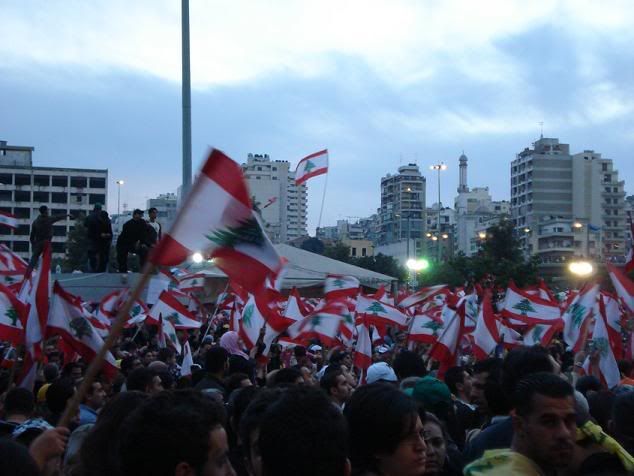
Protesters wave Lebanese flags downtown in hopes of pressuring PM Siniora to resign.
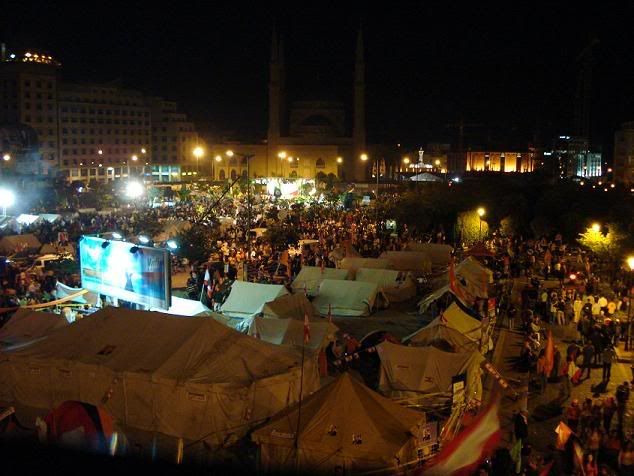
Downtown has turned into a festive tent city, with hundreds of thousands converging on the capital to show the government their discontent.
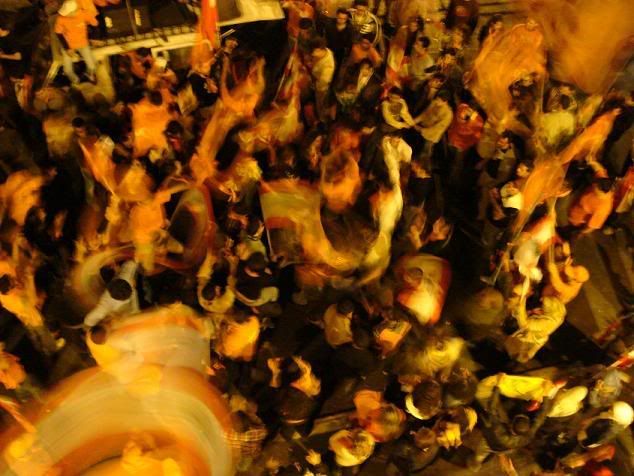
Opposition supporters come together to dance underneath the overpass, which houses many who are camping here until the government resigns or expands the opposition's representation in the cabinet.
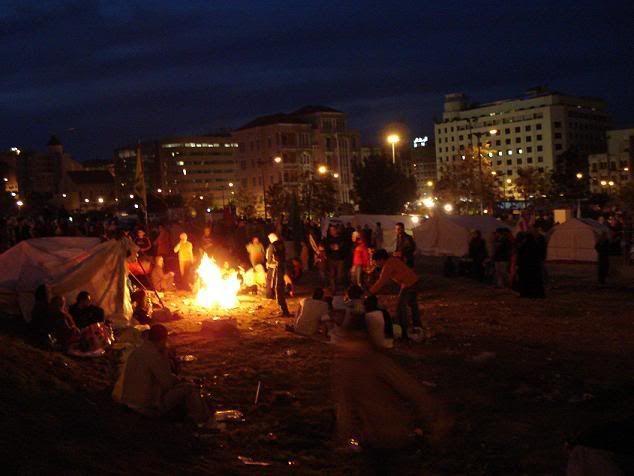
Protesters get ready for the evening by lighting up camp fires.
Subscribe to:
Posts (Atom)
Wednesday, December 20, 2006
Break...
I'm off to al-Andalus until the new year, so I doubt that I'll be posting...
Happy holidays.
Setting Lebanon Free
I meant to mention this the other day, but it slipped my mind. Robert Grenier, former director of the CIA's counterintelligence center, thinks that if the US loves Lebanon, we should set it free.
ONCE more, Lebanon is in political crisis. This time, we are told, it pits "Syrian- and Iranian-backed" Shiite parties (Hezbollah and Amal) and the Christian faction led by Michel Aoun against the "Western-backed" Christian, Sunni and Druze groups that support the government of Prime Minister Fouad Siniora.
These very descriptions -- citing one external backer or another as a mark of political identification -- illustrate the fundamental problem Lebanon must overcome. Call it the Lebanese Disease: rather than sorting out their differences internally and addressing the fundamental injustices at the heart of their disputes, the Lebanese constantly look to outsiders to gain an advantage over their rivals.
Naturally, any advantages thus gained are short-lived, for both the Lebanese and their foreign backers. In the end, the only result is greater popular suffering and instability in Lebanon and the entire Middle East.
Only the Lebanese can cure themselves of this disease, but a bit of enlightened self-interest on the part of the "Western backers" -- primarily the United States and France ? would greatly help. It may seem counterintuitive, but the best hope for American interests in the Middle East is not to isolate and minimize Hezbollah, but to further integrate it politically, socially and militarily into the Lebanese state.
...It has long been obvious that the Shiites are under-represented in Lebanon's complicated power-sharing arrangements. In return for a greater measure of political representation for Shiites, Mr. Siniora could have insisted that Hezbollah's militia be brought under some sort of state control -- perhaps as a sort of home guard for the south, with its fighters under the command of senior officers drawn from the Lebanese armed forces.
...A far more genuine American commitment to Lebanon would focus on helping the parties to come up with a reasonable formula to redress the under-representation of Shiites in the power structure while getting greater government control over Hezbollah's war-making capacity.
Tuesday, December 19, 2006
Shouting across the divide
This American Life has an excellent piece on bridging the gap between Muslims and non-Muslims. The segment is about the statue of Mohammad in the Supreme Court, a Muslim-American family whose life is wrecked by a evangelizing fourth grade teacher, and an ad exec who tries to sell brand America. You can listen to the show or download it as an mp3 until later this week.
In the first story, the representative of CAIR tries to explain why Muslims don't appreciate the statue of Mohammad, even if it is supposed to be inclusive. In the second, a fourth-grade teacher reads her students a book on how Muslims hate America and Christians for the anniversary of 9/11 then explains to the only Muslim child how she and her family will go to hell if they don't accept the blood of Jesus. Finally, the third segment shows the difficulty of using the same formula to sell Coke to sell America might not work and explores a possible slogan about Muslim control of Islam's holy cities Mecca, Medina and Jerusalem: "Two outta three ain't bad!"
Monday, December 18, 2006
Petrodollars to petro-euros
Tehran has just announced that Iran will be converting all of its assets, holdings, reserves and accounting from US dollars to euros.
I remember there being talk during the run-up to the war in Iraq that one of the reasons for the invasion of Iraq was to reverse Saddam's decision to dump the dollar for the Euro. Whether or not Baghdad's decision to trade in euros, which incidentally made Iraq a lot of money, had anything to do with the invasion is unclear. To be honest, I don't understand enough about monetary policy to know exactly how OPEC countries' changing to Euros would affect the US economy, except for a vague sense that the results would be less than positive for America. I would, however, be willing to bet that Iraq now only trades in US dollars.
We'll see what effect Iran's decision will have, but if I had to guess, I'd say that it hasn't helped relations between Washington and Tehran.
Sunday, December 17, 2006
On civil war in Iraq
Safire is debating the usage "civil war" in describing Iraq. Personally, I took to calling a spade a spade almost a year and a half ago.
Safire makes a point of boasting about his easy access to president Talibani, who "definitively" does not call it a civil war, and he quotes Bill Keller, the executive editor of the Times who makes the following point:
I bristle at the way a low-grade semantic argument has become -- at least among the partisan cud-chewers -- a substitute for serious discussion of what's happening in Iraq and what to do about it. ... Maybe this argument is a symptom of intellectual fatigue in the punditocracy.
So while I can agree that a lot of people are arguing about what to call it while not thinking enough about what to do there, I don't agree with Safire, who in the end, thinks that it's just a value judgement:
Call the fighting what you like, but the name you choose to give the hostilities, strife, violence or war not only reflects your view about the current state of affairs but is also an indication of where you stand on what our policy should be. Labels are the language's shorthand for judgments.
I disagree. Words have meaning. So although it's true that certain people push for the civil war in Iraq to be called one thing or another for ideological reasons, that does not mean that one label is more or less accurate than another. And when Safire's Kurdish friend argues that
There is a more complex dynamic to this than civil war... There is Shia versus Shia, Sunni versus Sunni, Shia versus Sunni and Shia and Sunni versus Al Qaeda, as well as militias against the authority of the elected government. Many act as the proxies of regional powers, so you can call it as much a proxy war as a civil war.
I have a hard time thinking that he's being anything but disingenuous, since, if anything, the Lebanese civil war was even more complex. There, we saw 18 confessional groups lining up with over half a dozen foreign powers (Israel, Syria, Iraq, US, France, Italy, etc.) and the Palestinians, who were somewhat in between a domestic and a foreign force. Does anyone call that anything other than a civil war? So why should Iraq be any different?
Sunday, December 10, 2006
Underqualified
I read this IHT Op-Ed by Jeff Stein last October with a mixture of sad resignation and sighing wonderment, thinking to myself that it's no wonder American foreign policy in the Middle East is so often so wrongheaded and obviously stupid. After all, if US counterterrorism officials and congressmen don't know answers to such basic questions as the difference between Sunni and Shi'a Muslims, or even to which sects Al-Qaeda, Iran and Hezbollah belong, how can they make informed decisions about issues that are based on underlying differences between the region's actors?
So I have to say that while I'm not surprised, I am certainly disappointed to see that the newly appointed Democratic intelligence chairman is equally uninformed (via Ezra):
...like a number of his colleagues and top counterterrorism officials that I've interviewed over the past several months, Reyes can't answer some fundamental questions about the powerful forces arrayed against us in the Middle East.
It begs the question, of course: How can the Intelligence Committee do effective oversight of U.S. spy agencies when its leaders don't know basics about the battlefield?
...Reyes stumbled when I asked him a simple question about al Qaeda at the end of a 40-minute interview in his office last week. Members of the Intelligence Committee, mind you, are paid $165,200 a year to know more than basic facts about our foes in the Middle East.
We warmed up with a long discussion about intelligence issues and Iraq. And then we veered into terrorism's major players.
To me, it's like asking about Catholics and Protestants in Northern Ireland: Who's on what side?
The dialogue went like this:
Al Qaeda is what, I asked, Sunni or Shia?
"Al Qaeda, they have both," Reyes said. "You're talking about predominately?"
"Sure," I said, not knowing what else to say.
"Predominantly -- probably Shiite," he ventured.
...And Hezbollah? I asked him. What are they?
"Hezbollah. Uh, Hezbollah..."
He laughed again, shifting in his seat.
"Why do you ask me these questions at five o'clock? Can I answer in Spanish? Do you speak Spanish?"
"Pocito," I said -- a little.
"Pocito?!" He laughed again.
"Go ahead," I said, talk to me about Sunnis and Shia in Spanish.
Reyes: "Well, I, uh...."
Stein goes on to tell us how the woeful ignorance of the region goes all the way from the top of the chain of command to those on the ground -- the employees of the embassy in Baghdad. It seems that of all the Americans at the embassy in Iraq, there are only six fluent Arabic speakers and two dozen who have some familiarity with the language. This is out of over a thousand employees.
There is definitely a dearth of specialists of the region and speakers of its languages. And those in charge don't seem very concerned about it, since according to the Department of Defense, between 1993 and 2003, 55 Arabic speakers and 9 Farsi speakers have been fired in accordance with the US military's policy of "Don't ask, Don't tell."
The 9/11 commission report decried the lack of Arabic speakers, a situation that has led to a huge backlog of untranslated documents in the government's counterterrorism efforts. It seems not only disheartening but disconcerting that ideological issues such as one's sexual orientation would trump national security concerns.
So while I'm glad to see that some of those who pushed the most ferociously for war in Iraq will no longer be in a position to decide foreign policy in the region, I'm afraid that their Democratic counterparts aren't any more qualified to make such important decisions.
Friday, December 08, 2006
Peace not apartheid in Palestine
Jimmy Carter, responding to the reaction his new book has received, has a sincere and thoughtful piece in the LA Times on speaking frankly about Israel and Palestine:
The many controversial issues concerning Palestine and the path to peace for Israel are intensely debated among Israelis and throughout other nations ? but not in the United States. For the last 30 years, I have witnessed and experienced the severe restraints on any free and balanced discussion of the facts. This reluctance to criticize any policies of the Israeli government is because of the extraordinary lobbying efforts of the American-Israel Political Action Committee and the absence of any significant contrary voices.
It would be almost politically suicidal for members of Congress to espouse a balanced position between Israel and Palestine, to suggest that Israel comply with international law or to speak in defense of justice or human rights for Palestinians. Very few would ever deign to visit the Palestinian cities of Ramallah, Nablus, Hebron, Gaza City or even Bethlehem and talk to the beleaguered residents. What is even more difficult to comprehend is why the editorial pages of the major newspapers and magazines in the United States exercise similar self-restraint, quite contrary to private assessments expressed quite forcefully by their correspondents in the Holy Land.
While I disagree with Carter on the idea of a two-state solution (I believe the only tenable solution to the conflict is a single democratic state where one person has one vote), I agree wholeheartedly with the problems that arise in the US when one wants to have an honest discussion about Israel/Palestine.
Proving his point, we can see that this is the kind of reaction that genuine discourse, such as Carter's gets in the US. Of course this elder statesman handles himself with propriety and grace, neither of which such mean-spirited and asinine attacks really warrant.
Tuesday, December 05, 2006
The Pulitzer and an Iranian execution
The Wall Street Journal has an excellent piece on photographs of executed Kurds during the Iranian revolution and the photographer who until now has remained anonymous.
Sunday, December 03, 2006
One reported dead in street violence in Beirut
According to Lebanese television, a group of Shia protesters were walking home from the protest to their neighborhood near the Shatilla refugee camp. Apparently, they were attacked by a group of March 14 supporters, but it is unsure if the attackers were Sunni or Christian.
The details are still coming out, but it seems a Shia youth of twenty years was shot and killed by the attackers. Another in the group may have been stabbed as well.
This is really disconcerting, not only for the obvious reason that someone was murdered in the street, but for the fact that up until now, clashes between opposition supporters and government supporters had stayed at a minimum. I can imagine that this sort of an act will not go without a reprisal from Shia groups.
Opposition supporters interviewed on television stated that the March 14 group had their protest last week without any attacks by opposition supporters and were dismayed that they were not left alone to protest peacefully.
Up till now, I've been fairly optimistic about a peaceful solution to the political tensions here, but now I'm not so sure. This is just the sort of senseless act of violence that could spark a civil war.
UPDATE: The AP has a wire story on the event, and apparently it was Sunnis who killed the Shia boy:
Violent clashes broke out Sunday between Shiite and Sunni Muslims in the capital, leaving one man dead from gunshot wounds at a time when tensions throughout Lebanon threaten the country's fragile sectarian and political balance.
...The clash in Tarik Jdideh occurred as a group of Hezbollah supporters were returning from Beirut's downtown and passed through the Sunni neighborhood.
Police officials said the two sides threw stones at each other, then shots were fired, killing Ahmed Ali Mahmoud, a 20-year-old Shiite. The officials spoke on condition of anonymity because they were not allowed to speak to the press.
At least 10 other people were slightly injured elsewhere in West Beirut in similar clashes.
What's really happening in Beirut
I just got off the phone with my father in the US. He immediately started giving me a lecture on Lebanese politics, if you can call it that. Generally speaking, I can count on my father to represent the red-state everyman, whether the topic is foreign policy or domestic affairs. He's worried about me being in Beirut, which is normal, especially since the Arab world is a region that seems very foreign and even threating to him.
He brought up the protests and how the situation was getting dangerous in Lebanon. I told him that I had actually just come back from them and that the mood was festive, nonviolent and, ultimately, democratic. He told me that no, Hezbollah was just a bunch of terrorists and that they aren't democratic and that they're trying to take over the country.
Things always start deteriorating when I can't hold my tongue in these situations. I told him that if he was interested in knowing the specifics of the situation, I could explain them to him, but I was not interested in getting a lecture on Lebanese politics from someone who doesn't know anything about the subject.
However, as a representative of the American mindset, one of his sentences stuck in my mind: "Everyone knows the Hezbollah terrorists are trying to take over the government." Speaking from an American view point, he's probably right. Everyone knows what's happening. Of course they don't actually know what's going on here, but that doesn't make their certainty any less headstrong.
I went down to the protests again today. If you hadn't been following the situation here and didn't speak any Arabic, you might think that everyone had showed up in Beirut for a music festival, or maybe an independence day celebration or some other national holiday.
Downtown has turned into a souk, with people hawking political flags and shirts out of the trunk of their cars or on tables set up in the newly formed tent village. Vendors sell warm food, cigarettes and cold drinks. Shia clerics stand next to young women with abundant cleavage and bear shoulders. Supporters of Hezbollah and Amal mingle with Christian supporters of General Aoun and communists who hock Che scarves and Lebanese flags with a hammer and sickle on them.
Youth congregate together drawing into circles to dance and sing while drums are beaten loudly. Children have faces painted red, white and green to mirror the Lebanese flag, sometimes with a small flag on each cheek, other times with the a single taking up the entire face, the centered ceder formed by a small nose. The sound of two teacups click-clacking together calls those protesters who would like to sit down and warm up with a cup of hot tea. Barbecue grills are set up, some selling food while other sell hot coals for the myriad of water pipes everyone seems to be smoking between chanting slogans and waving flags. These are the "terrorists" my father was lecturing me about.
As dusk falls, some protesters gather into buses to make the trip back home while others start fires to keep themselves warm next to their tents. Downtown feels alive and vibrant, religiously and socially mixed -- somewhat like I imagine it being before the civil war and before it was revamped into an expensive simulacrum of its former self.
Protesters wave Lebanese flags downtown in hopes of pressuring PM Siniora to resign.
Downtown has turned into a festive tent city, with hundreds of thousands converging on the capital to show the government their discontent.
Opposition supporters come together to dance underneath the overpass, which houses many who are camping here until the government resigns or expands the opposition's representation in the cabinet.
Protesters get ready for the evening by lighting up camp fires.
Subscribe to:
Posts (Atom)