In the vein of the NYC version, this was overheard in the halls of a prestigious private university here in Beirut:
Young woman on cell phone: Yeah, I would, biss ma'aoul racism? You're college educated! Come on, I'm so disappointed!
Thursday, May 08, 2008

Pictures from strike, protest and clashes
The LA Times has a good slide show of a few pictures from yesterday's bullshit.

An armed supporter of the Shiite Amal movement walks past smoldering cars in Beirut during a general strike that turned into a confrontation between rival political factions.
An armed supporter of the Shiite Amal movement walks past smoldering cars in Beirut during a general strike that turned into a confrontation between rival political factions.
Wednesday, May 07, 2008
Strike turns into street fighting
 What was supposed to be a general strike over the minimum wage (the demonstration for which was finally canceled) has turned in to street clashes between Sunni and Shi'a. As usual. I crossed over to West Beirut this morning and back just now by the port road, and besides the empty streets and smoke in the air from burnt tires up by the tent city, nothing was out of the ordinary. Watching the news, however, I can see that at one point the highway was blocked with burned out tires.
My friend S, on the other hand, lives in Corniche el-Mazra'a, where there has been fighting most of the day. She just told me that they haven't seen any army troops in over an hour, just militiamen from Amal and Mostaqbal (Future Movement) carrying guns and RPG launchers. They don't have any electricity and have had to leave the living room, because the windows are too big. There have been other clashes in the usual places: Cola, Museitbeh, Tariq el-Jadida, Tayounneh and Ras el-Naba'a, amongst others.
It's really depressing to me how even an issue like raising the minimum wage, which should have appeal across sectarian lines, inevitably turns into an excuse for thugs from vying political parties to fight in the street.
Monday, May 05, 2008
Put yourself in her shoes
I'm a little late for Labor Day, but Human Rights Watch here in Lebanon has begun an awareness campaign for rights of domestic workers entitled Put Yourself in Her Shoes:

The condition of (predominantly women) domestic workers in the Middle East is atrocious. Apparently, the problem is as bad in Israel as it is in Lebanon and even worse in Saudi Arabia and the Emirates. According to HRW:
The most common complaints made by domestic workers to embassies and nongovernmental organizations include non-payment or delayed payment of their wages, forced confinement to the workplace, no time off, and verbal, as well as physical, abuse. According to a 2006 survey conducted by Dr. Ray Jureidini of 600 migrant domestic workers, 56 percent said they work more than 12 hours a day and 34 percent have no regular time off. In some cases, workers have died while attempting to escape these conditions, some by jumping from balconies.
...The Lebanese authorities have failed to curb abuses committed by employers and agencies. Lebanese labor laws specifically exclude domestic workers from rights guaranteed to other workers, such as a weekly day of rest, limits on work hours, paid holidays, and workers’ compensation. Immigration sponsorship laws restrict domestic workers’ ability to change employers, even in cases of abuse. An official steering committee created in early 2006 and led by the Ministry of Labor to improve the legal situation of migrant workers in Lebanon has yet to deliver any concrete reforms. This includes a long-discussed standard contract to outline minimum standards for domestic workers’ employment.
Human Rights Watch called upon the Ministry of Labor and other relevant authorities to amend the labor law to extend equal protection for domestic workers and to sign and ratify the International Convention on the Protection of the Rights of All Migrant Workers and Members of their Families.
 A few years ago, the Times did a story about Sri Lankan women who go to the Middle East to work as domestic servants. This picture is of a 20-year-old woman named Thangarasa Jeyanthi who was severely abused in Lebanon. In Lebanese Arabic, the common word for a domestic worker is "Sri Lankan." At one point, I remember hearing a joke about an NGO that was fostering multiculturalism by doing presentations with people from all over world invited to introduce themselves to the audience. The Egyptian man comes and says he works as a concierge. The Syrian says that he's a field hand. And then comes the Ethiopian who introduces herself but forgets to say what her profession is. When reminded that everyone has to say what they do, she replies, "I'm a Sri Lankan."
In the case of Sri Lankan women, the conditions that they live and work in criminally miserable, and their government is actually complicit. There are training programs that teach the women some Arabic and how to do what is expected of them without receiving the beatings that are so common. The government encourages women to go to the Middle East, they provide remittances that help keep the Sri Lankan economy afloat.
An Ethiopian friend of mine here used to work for a big hotel in town, but she wasn't allowed to be hired directly even though she has all of her papers in order. The hotel insists on going through a middle man, who garnishes half of the wages of the foreign women working at the hotel. A salary of $450 is reasonable (and more than twice the pitiful minimum wage), but when some sleazy profiteer gets to pocket half of your salary, it's difficult to survive, especially with the increasing price of living (many food items have nearly doubled in price in the last 9 months).
In contrast with Colombo's policy of encouraging the migration, Ethiopia's government has taken the decision to ban its citizens from coming to Lebanon in search of employment:
ADDIS ABABA: On the occasion of Labor Day, Ethiopia has officially banned its citizens from traveling to Beirut in search of jobs, the African country's Ministry of Labor and Social Affairs has disclosed. Ethiopia passed the bill after it probed the human right violations and domestic violence Ethiopian migrants face behind closed doors in Beirut while employed as maids.
"Suspending work travel to Beirut was the only solution to minimizing the human rights abuses and dangers facing our citizens," said Zenebu Tadesse, deputy minister of state for labor and social affairs.
During the past few years, a number of Ethiopians have died in Lebanon in questionable circumstances.
According to a report published by Ethiopia's official news agency, past human right records show that 67 Ethiopian women have died between 1997 and 1999 alone while working in Beirut.
The ministry said it would take strong action against any employment agency trying to send workers directly to Beirut or through a third country.
So for Labor Day this year, I'd like to remind everyone that Sri Lankan is a nationality, not a profession. And I'd like to remind the Lebanese, many of whom go off to Europe, North America and the Gulf in search of work, that they should have a little solidarity with domestic workers here who are hoping to make so money to create a better life for themselves. As my friend Nadim from HRW says about their media campaign: "Many Lebanese themselves have been forced by wars and hardships to emigrate looking for a better life. We hope that they will see the parallels with the experience of these migrants that came from far away to care for Lebanese families."
Carter gets what he deserves
(Via my friend A) Carter to be tried for peace crimes, according to The Onion:
GENEVA, SWITZERLAND—An international peace-crimes tribunal commenced legal proceedings against former U.S. President Jimmy Carter for alleged crimes against inhumanity Monday.
"Jimmy Carter's political career includes a laundry list of anti-war-making offenses," said chief prosecutor Charles B. Simmons. "Carter's record of benevolence, diplomacy, and respect for human life is unrivaled in recent geopolitical history. For millions, the very sight of his face evokes memories of his administration's reign of tolerance."
I knew it was only a matter of time before the international community succeeded in bringing his gentle reign of peace-mongering to an end!
One man's terrorist
Raymond Tanter from WINEP and MESH has a post up about why the Mujahedeen-e Khalq (MEK), the Iranian militants who have committed terrorist attacks against the regime in Teheran and who were hosted by Saddam's Iraq, should be delisted from the State Department's list of terrorist organizations. Besides the fact that the MEK is against the Iranian regime, basically, his argument boils down to the fact that they haven't committed any acts of terrorism for a few years:
On April 25, Patrick Clawson, deputy director of research at The Washington Institute for Near East Policy, wrote that designation “should be based only on terrorism issues,” and that State “cited no alleged MEK terrorist activity since 2001, yet have increased allegations pertaining [to] the group’s non-terrorist activities.” Country Reports 2007 continues this trend of making allegations that are irrelevant to terrorist designation.
Tanter attempts to argue that MEK doesn't have the capability to carry out terrorist attacks, whereas we all know that anyone with a back pack, a bus pass and household peroxide can commit an act of terrorism. So while this argument isn't very convincing, he tells us, "de-listing would provide diplomatic leverage over Tehran, as the West is presently failing to constrain the Iranian regime’s nuclear program, sponsorship of terrorism, and subversion of Iraq."
In other words, the US should use a terrorist group for political bargaining. Of course this is nothing new: the Bush family has a long history of using Cuban terrorists to apply pressure on the Castro regime. What's striking, though, is the moral indignation Republicans muster when someone supports talking to groups like Hamas, the Muslim Brotherhood and Hezbollah (most of the violence committed by the last group having been aimed at military targets). Charges of moral equivalency and weak knees in the face of terror are immediately brandished.
Well, Orlando Bosch blew up a passenger plane killing all 73 civilians aboard. Jose Dionisio Suarez and Virgilio Paz Romero assassinated the Chilean diplomat Orlando Letelier in Washington. The Mujahedeen-e Khalq assassinated the deputy chief of the Iranian Armed Forces General Staff, Brigadier General Ali Sayyaad Shirazi and attacked Iranian embassies and installations in 13 different countries at the same time. They also bombed the head office of the Islamic Republic Party and the Prime Minister's office killing 70 people, including the Chief Justice, the President and the Prime Minister.
Either terrorism is an acceptable tactic, or it's not. Washington can't understand why the rest of the world sees America as hypocritical, but Tanter's desire for the US to have its cake and eat it too should give us a hunch.
UPDATE: Thinking more about this today has reminded me of the question of when a group can legitimately be de-listed as a terrorist organization. If the fact that MEK hasn't committed any acts of terrorism since 2001 is really enough to prove that they've mended their ways, then the same ought to apply to Hezbollah as well, because depending on who was responsible for the Argentinean attacks and the kidnapping of Tannenbaum, they haven't committed any acts of terrorism since 2000, the mid-1990s or even the late 1980s.
Otherwise, supporting terrorist groups or rebels or militias in a neighboring country has long been a staple of statecraft. In Africa, Sudan, Chad, Ethiopia, Uganda and Eritrea each support groups in their neighbors' territory. Iran and Syria support Hamas and Hezbollah; Syria supported the PLO in Jordan; while Israel supported the SLA in Lebanon; and Iran trained the Iraqi Badr Brigage to fight against Saddam. Hell, the first car bomb in Iraq wasn't unleashed by Zarqawi, but rather by Iyad Allawi with the help of the CIA. So while I abhor the use of violence against civilians as a political tool, I'm not naive and do know it happens all over. It's the smug hypocrisy of the "War on Terror" that really gets my goat in the same way that the "Fair and Balanced" slogan annoys me way more than the actual Fox News coverage.
Nakba use in the Times
The previous post got me to wondering how often the word Nakba had been used in American newspapers and when, so I did a Lexis Nexis search, which showed that the Times has only printed the word in 34 articles, the first of which appeared in 1998 in an article about Israel's 50th anniversary. A double check of the NYT online archives, however, showed two other articles that didn't appear in the Lexis Nexis search (they seem to only have abstracts for pre-1981 articles): one from 1973 on Sadat and another from 1970 on occupied Ramallah.
Here's a quickly drawn up chart that tracks the use of the word in coverage by the New York Times:
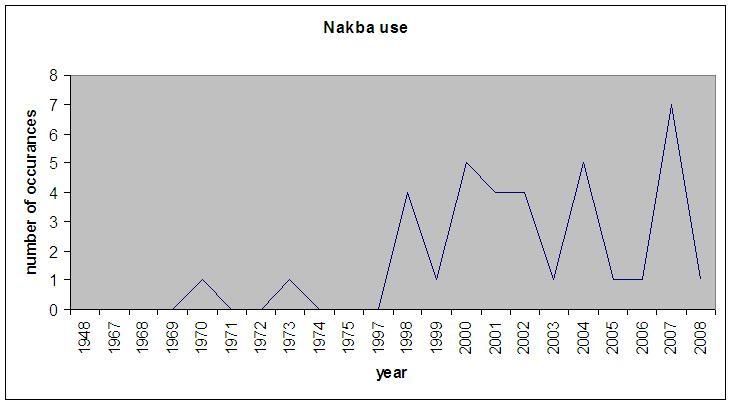
This shows that up until the 50th anniversary of the Nakba, the Times had referred to it but twice. I have a feeling that before the year is over, 2008 will beat out 2007 for the number of times the term is employed.
It's unclear to me what exactly has caused the general tide of public opinion to start moving (slowly but surely) away from Israeli occupation in the US. (Or perhaps I'm being optimistic and am projecting?) But I get the feeling that there's a shift happening in American public opinion that will hopefully be reflected by more fair-minded media coverage of the Israeli-Palestinian conflict.
Nakba denial
I've been surprised in the last few weeks to see how much attention the Nakba is getting during the run up to the 60th anniversary of the catastrophe and the founding of the Jewish state. While interpretations differ, it has at least been getting mentions in publications like The New Yorker and the New York Times.
That said, I knew it was only a matter of time before something really reactionary and stupid came out in a magazine like Commentary. Well, Efraim Karsh offers up exactly what we needed in his "True Story" of what happened in 1948. Following his recent comments on the "Jordanian option," I recently marveled how someone who is ostensibly a scholar of the region could be so out of touch with Arabs and the Arab political scene, but this latest piece takes the proverbial cake.
According to Karsh, before 1948, the Palestinians never had any problem with the idea of becoming a minority in their own land and otherwise would have been perfectly happy living as a second class majority in a Jewish state. In fact, Zionists wanted nothing more than all Arabs to stay in their homes and live happily ever after in a pastoral paradise. Unfortunately, the evil Jew-hating "Arab leaders" had to dash all these wonderful hopes and spur the Palestinians to war, despite the fact that they wanted nothing more than to live in a Jewish state. Why even Vladimir Jabotinsky wanted nothing more than peaceful Arab-Jewish coexistence: According to Karsh:
The simple fact is that the Zionist movement had always been amenable to the existence in the future Jewish state of a substantial Arab minority that would participate on an equal footing “throughout all sectors of the country’s public life.” The words are those of Ze’ev Jabotinsky, the founding father of the branch of Zionism that was the forebear of today’s Likud party. In a famous 1923 article, Jabotinsky voiced his readiness “to take an oath binding ourselves and our descendants that we shall never do anything contrary to the principle of equal rights, and that we shall never try to eject anyone.”
Eleven years later, Jabotinsky presided over the drafting of a constitution for Jewish Palestine. According to its provisions, Arabs and Jews were to share both the prerogatives and the duties of statehood, including most notably military and civil service. Hebrew and Arabic were to enjoy the same legal standing, and “in every cabinet where the prime minister is a Jew, the vice-premiership shall be offered to an Arab and vice-versa.”
It just so happens that this is the same Jabotinsky who thought that the Jewish state should encompass both sides of the Jordan and who in his famous essay, "The Iron Wall," had this to say:
If [the reader] should attempt to seek but one instance of a country settled with the consent of those born there he will not succeed. The inhabitants (no matter whether they are civilized or savages) have always put up a stubborn fight.
...Any native people -- its all the same whether they are civilized or savage -- views their country as their national home, of which they will always be the complete masters. They will not voluntarily allow, not only a new master, but even a new partner. And so it is for the Arabs. Compromisers in our midst attempt to convince us that the Arabs are some kind of fools who can be tricked by a softened formulation of our goals, or a tribe of money grubbers who will abandon their birth right to Palestine for cultural and economic gains. I flatly reject this assessment of the Palestinian Arabs. Culturally they are 500 years behind us, spiritually they do not have our endurance or our strength of will, but this exhausts all of the internal differences. We can talk as much as we want about our good intentions; but they understand as well as we what is not good for them. They look upon Palestine with the same instinctive love and true fervor that any Aztec looked upon his Mexico or any Sioux looked upon his prairie. To think that the Arabs will voluntarily consent to the realization of Zionism in return for the cultural and economic benefits we can bestow on them is infantile. This childish fantasy of our “Arabo-philes” comes from some kind of contempt for the Arab people, of some kind of unfounded view of this race as a rabble ready to be bribed in order to sell out their homeland for a railroad network.
He goes on to say that no voluntary agreement with the Arabs is possible:
Thus we conclude that we cannot promise anything to the Arabs of the Land of Israel or the Arab countries. Their voluntary agreement is out of the question. Hence those who hold that an agreement with the natives is an essential condition for Zionism can now say “no” and depart from Zionism. Zionist colonization, even the most restricted, must either be terminated or carried out in defiance of the will of the native population. This colonization can, therefore, continue and develop only under the protection of a force independent of the local population -- an iron wall which the native population cannot break through. This is, in toto, our policy towards the Arabs. To formulate it any other way would only be hypocrisy.
...All this does not mean that any kind of agreement is impossible, only a voluntary agreement is impossible. As long as there is a spark of hope that they can get rid of us, they will not sell these hopes, not for any kind of sweet words or tasty morsels, because they are not a rabble but a nation, perhaps somewhat tattered, but still living. A living people makes such enormous concessions on such fateful questions only when there is no hope left. Only when not a single breach is visible in the iron wall, only then do extreme groups lose their sway, and influence transfers to moderate groups. Only then would these moderate groups come to us with proposals for mutual concessions. And only then will moderates offer suggestions for compromise on practical questions like a guarantee against expulsion, or equality and national autonomy.
I am optimistic that they will indeed be granted satisfactory assurances and that both peoples, like good neighbors, can then live in peace. But the only path to such an agreement is the iron wall, that is to say the strengthening in Palestine of a government without any kind of Arab influence, that is to say one against which the Arabs will fight. In other words, for us the only path to an agreement in the future is an absolute refusal of any attempts at an agreement now.
This is what Jabotinsky thought of the Arabs, not just in Palestine but in Jordan as well. To the consternation of modern day Zionists, he saw the Zionist state in explicitly colonial terms, equating it with other European colonial endeavors.
Now I've got a certain respect for Zionists like Jabotinsky who call a spade a spade. What I don't appreciate are scholars like Karsh who insist on whitewashing the creation of Israel to absolve the state of any wrong-doing. In his world, the Yishuv did nothing wrong; all blame for the problems of Arabs can be squarely placed at the feet of "Arab leaders." He ignores the much more frank assertions of the Zionist leaders themselves, like Ben-Gurion who once asked:
Why should the Arabs make peace? If I was an Arab leader I would never make terms with Israel. That is natural: we have taken their country. Sure God promised it to us, but what does that matter to them? Our God is not theirs. We come from Israel, but two thousand years ago, and what is that to them? There has been antisemitism, the Nazis, Hitler, Auschwitz, but was that their fault? They only see one thing: we have come here and stolen their country.
In any case, Karsh disagrees with the scholarship done by Israeli "new historians" like Pappe, Morris and Shlaim, who all show that the old myths of Palestinians leaving their homes because of radio broadcasts sent out by their leaders are conveniently simplistic and just not true. While there is some disagreement as to whether the ethnic cleansing of Palestine was pre-planned and deliberate, ad-hoc and hasty or unintentional but finally welcome, the issue is ultimately beside the point when it comes to Palestinians' right of return. Either you believe that one has the unalienable right to leave one's country and return, or you don't.
Thursday, May 01, 2008
Give us your tired, your poor, your huddled masses...
...yearning to breathe free, so we can pour water down their throats.
For all of our grandstanding rhetoric about freedom agendas and human rights and liberty and justice for all, I can't help but wonder what it says about us as a country that Amnesty International feels that this commercial is necessary:
Iran in Iraq
McClatchy has an interesting piece on Iranian Brig. Gen. Qassem Suleimani, the head of the Revolutionary Guard's Quds Force. The story includes an awfully high percentage of anonymous sources, and the title might be a little hyperbolic, but I think the overall points made are fair enough.
Iran has a lot of sway in Iraq, which is normal. What's silly, though, is that Americans see this as some sort of meddling, because Iranian interests in Iraq are not always the same as American interests (although I'd argue that they coincide much more often than either side would like to admit). If Iran were occupying Mexico or Canada, you can be sure that the US would be "meddling" as well.
As for the actual article, I don't really have too much to add, except that it's important to look at Iranian involvement in Iraq not as a spoiler or as some diabolical force. If the US is going to come to terms with Middle Eastern players (of which Iran has become a major one, due in no small part to American intervention in Afghanistan and Iraq), Washington is going to have to look at Teheran (and Damascus and Hezbollah and Hamas, for that matter) as actors who have interests in the region that can't be run over roughshod by America.
This is a reality. So just as when one deals with Zimbabwe, it's necessary to take Pretoria into account, or how when dealing with Burma or North Korea one can't ignore Beijing, the road to peace in Iraq must necessarily pass through Teheran, but not in the way that American hawks would like it to.
Subscribe to:
Posts (Atom)
Thursday, May 08, 2008
Overheard in Beirut
In the vein of the NYC version, this was overheard in the halls of a prestigious private university here in Beirut:
Young woman on cell phone: Yeah, I would, biss ma'aoul racism? You're college educated! Come on, I'm so disappointed!
Young woman on cell phone: Yeah, I would, biss ma'aoul racism? You're college educated! Come on, I'm so disappointed!
Pictures from strike, protest and clashes
The LA Times has a good slide show of a few pictures from yesterday's bullshit.
An armed supporter of the Shiite Amal movement walks past smoldering cars in Beirut during a general strike that turned into a confrontation between rival political factions.
An armed supporter of the Shiite Amal movement walks past smoldering cars in Beirut during a general strike that turned into a confrontation between rival political factions.
Wednesday, May 07, 2008
Strike turns into street fighting
What was supposed to be a general strike over the minimum wage (the demonstration for which was finally canceled) has turned in to street clashes between Sunni and Shi'a. As usual. I crossed over to West Beirut this morning and back just now by the port road, and besides the empty streets and smoke in the air from burnt tires up by the tent city, nothing was out of the ordinary. Watching the news, however, I can see that at one point the highway was blocked with burned out tires.
My friend S, on the other hand, lives in Corniche el-Mazra'a, where there has been fighting most of the day. She just told me that they haven't seen any army troops in over an hour, just militiamen from Amal and Mostaqbal (Future Movement) carrying guns and RPG launchers. They don't have any electricity and have had to leave the living room, because the windows are too big. There have been other clashes in the usual places: Cola, Museitbeh, Tariq el-Jadida, Tayounneh and Ras el-Naba'a, amongst others.
It's really depressing to me how even an issue like raising the minimum wage, which should have appeal across sectarian lines, inevitably turns into an excuse for thugs from vying political parties to fight in the street.
Monday, May 05, 2008
Put yourself in her shoes
I'm a little late for Labor Day, but Human Rights Watch here in Lebanon has begun an awareness campaign for rights of domestic workers entitled Put Yourself in Her Shoes:
The condition of (predominantly women) domestic workers in the Middle East is atrocious. Apparently, the problem is as bad in Israel as it is in Lebanon and even worse in Saudi Arabia and the Emirates. According to HRW:
The most common complaints made by domestic workers to embassies and nongovernmental organizations include non-payment or delayed payment of their wages, forced confinement to the workplace, no time off, and verbal, as well as physical, abuse. According to a 2006 survey conducted by Dr. Ray Jureidini of 600 migrant domestic workers, 56 percent said they work more than 12 hours a day and 34 percent have no regular time off. In some cases, workers have died while attempting to escape these conditions, some by jumping from balconies.
...The Lebanese authorities have failed to curb abuses committed by employers and agencies. Lebanese labor laws specifically exclude domestic workers from rights guaranteed to other workers, such as a weekly day of rest, limits on work hours, paid holidays, and workers’ compensation. Immigration sponsorship laws restrict domestic workers’ ability to change employers, even in cases of abuse. An official steering committee created in early 2006 and led by the Ministry of Labor to improve the legal situation of migrant workers in Lebanon has yet to deliver any concrete reforms. This includes a long-discussed standard contract to outline minimum standards for domestic workers’ employment.
Human Rights Watch called upon the Ministry of Labor and other relevant authorities to amend the labor law to extend equal protection for domestic workers and to sign and ratify the International Convention on the Protection of the Rights of All Migrant Workers and Members of their Families.
A few years ago, the Times did a story about Sri Lankan women who go to the Middle East to work as domestic servants. This picture is of a 20-year-old woman named Thangarasa Jeyanthi who was severely abused in Lebanon. In Lebanese Arabic, the common word for a domestic worker is "Sri Lankan." At one point, I remember hearing a joke about an NGO that was fostering multiculturalism by doing presentations with people from all over world invited to introduce themselves to the audience. The Egyptian man comes and says he works as a concierge. The Syrian says that he's a field hand. And then comes the Ethiopian who introduces herself but forgets to say what her profession is. When reminded that everyone has to say what they do, she replies, "I'm a Sri Lankan."
In the case of Sri Lankan women, the conditions that they live and work in criminally miserable, and their government is actually complicit. There are training programs that teach the women some Arabic and how to do what is expected of them without receiving the beatings that are so common. The government encourages women to go to the Middle East, they provide remittances that help keep the Sri Lankan economy afloat.
An Ethiopian friend of mine here used to work for a big hotel in town, but she wasn't allowed to be hired directly even though she has all of her papers in order. The hotel insists on going through a middle man, who garnishes half of the wages of the foreign women working at the hotel. A salary of $450 is reasonable (and more than twice the pitiful minimum wage), but when some sleazy profiteer gets to pocket half of your salary, it's difficult to survive, especially with the increasing price of living (many food items have nearly doubled in price in the last 9 months).
In contrast with Colombo's policy of encouraging the migration, Ethiopia's government has taken the decision to ban its citizens from coming to Lebanon in search of employment:
ADDIS ABABA: On the occasion of Labor Day, Ethiopia has officially banned its citizens from traveling to Beirut in search of jobs, the African country's Ministry of Labor and Social Affairs has disclosed. Ethiopia passed the bill after it probed the human right violations and domestic violence Ethiopian migrants face behind closed doors in Beirut while employed as maids.
"Suspending work travel to Beirut was the only solution to minimizing the human rights abuses and dangers facing our citizens," said Zenebu Tadesse, deputy minister of state for labor and social affairs.
During the past few years, a number of Ethiopians have died in Lebanon in questionable circumstances.
According to a report published by Ethiopia's official news agency, past human right records show that 67 Ethiopian women have died between 1997 and 1999 alone while working in Beirut.
The ministry said it would take strong action against any employment agency trying to send workers directly to Beirut or through a third country.
So for Labor Day this year, I'd like to remind everyone that Sri Lankan is a nationality, not a profession. And I'd like to remind the Lebanese, many of whom go off to Europe, North America and the Gulf in search of work, that they should have a little solidarity with domestic workers here who are hoping to make so money to create a better life for themselves. As my friend Nadim from HRW says about their media campaign: "Many Lebanese themselves have been forced by wars and hardships to emigrate looking for a better life. We hope that they will see the parallels with the experience of these migrants that came from far away to care for Lebanese families."
Carter gets what he deserves
(Via my friend A) Carter to be tried for peace crimes, according to The Onion:
GENEVA, SWITZERLAND—An international peace-crimes tribunal commenced legal proceedings against former U.S. President Jimmy Carter for alleged crimes against inhumanity Monday.
"Jimmy Carter's political career includes a laundry list of anti-war-making offenses," said chief prosecutor Charles B. Simmons. "Carter's record of benevolence, diplomacy, and respect for human life is unrivaled in recent geopolitical history. For millions, the very sight of his face evokes memories of his administration's reign of tolerance."
I knew it was only a matter of time before the international community succeeded in bringing his gentle reign of peace-mongering to an end!
One man's terrorist
Raymond Tanter from WINEP and MESH has a post up about why the Mujahedeen-e Khalq (MEK), the Iranian militants who have committed terrorist attacks against the regime in Teheran and who were hosted by Saddam's Iraq, should be delisted from the State Department's list of terrorist organizations. Besides the fact that the MEK is against the Iranian regime, basically, his argument boils down to the fact that they haven't committed any acts of terrorism for a few years:
On April 25, Patrick Clawson, deputy director of research at The Washington Institute for Near East Policy, wrote that designation “should be based only on terrorism issues,” and that State “cited no alleged MEK terrorist activity since 2001, yet have increased allegations pertaining [to] the group’s non-terrorist activities.” Country Reports 2007 continues this trend of making allegations that are irrelevant to terrorist designation.
Tanter attempts to argue that MEK doesn't have the capability to carry out terrorist attacks, whereas we all know that anyone with a back pack, a bus pass and household peroxide can commit an act of terrorism. So while this argument isn't very convincing, he tells us, "de-listing would provide diplomatic leverage over Tehran, as the West is presently failing to constrain the Iranian regime’s nuclear program, sponsorship of terrorism, and subversion of Iraq."
In other words, the US should use a terrorist group for political bargaining. Of course this is nothing new: the Bush family has a long history of using Cuban terrorists to apply pressure on the Castro regime. What's striking, though, is the moral indignation Republicans muster when someone supports talking to groups like Hamas, the Muslim Brotherhood and Hezbollah (most of the violence committed by the last group having been aimed at military targets). Charges of moral equivalency and weak knees in the face of terror are immediately brandished.
Well, Orlando Bosch blew up a passenger plane killing all 73 civilians aboard. Jose Dionisio Suarez and Virgilio Paz Romero assassinated the Chilean diplomat Orlando Letelier in Washington. The Mujahedeen-e Khalq assassinated the deputy chief of the Iranian Armed Forces General Staff, Brigadier General Ali Sayyaad Shirazi and attacked Iranian embassies and installations in 13 different countries at the same time. They also bombed the head office of the Islamic Republic Party and the Prime Minister's office killing 70 people, including the Chief Justice, the President and the Prime Minister.
Either terrorism is an acceptable tactic, or it's not. Washington can't understand why the rest of the world sees America as hypocritical, but Tanter's desire for the US to have its cake and eat it too should give us a hunch.
UPDATE: Thinking more about this today has reminded me of the question of when a group can legitimately be de-listed as a terrorist organization. If the fact that MEK hasn't committed any acts of terrorism since 2001 is really enough to prove that they've mended their ways, then the same ought to apply to Hezbollah as well, because depending on who was responsible for the Argentinean attacks and the kidnapping of Tannenbaum, they haven't committed any acts of terrorism since 2000, the mid-1990s or even the late 1980s.
Otherwise, supporting terrorist groups or rebels or militias in a neighboring country has long been a staple of statecraft. In Africa, Sudan, Chad, Ethiopia, Uganda and Eritrea each support groups in their neighbors' territory. Iran and Syria support Hamas and Hezbollah; Syria supported the PLO in Jordan; while Israel supported the SLA in Lebanon; and Iran trained the Iraqi Badr Brigage to fight against Saddam. Hell, the first car bomb in Iraq wasn't unleashed by Zarqawi, but rather by Iyad Allawi with the help of the CIA. So while I abhor the use of violence against civilians as a political tool, I'm not naive and do know it happens all over. It's the smug hypocrisy of the "War on Terror" that really gets my goat in the same way that the "Fair and Balanced" slogan annoys me way more than the actual Fox News coverage.
Nakba use in the Times
The previous post got me to wondering how often the word Nakba had been used in American newspapers and when, so I did a Lexis Nexis search, which showed that the Times has only printed the word in 34 articles, the first of which appeared in 1998 in an article about Israel's 50th anniversary. A double check of the NYT online archives, however, showed two other articles that didn't appear in the Lexis Nexis search (they seem to only have abstracts for pre-1981 articles): one from 1973 on Sadat and another from 1970 on occupied Ramallah.
Here's a quickly drawn up chart that tracks the use of the word in coverage by the New York Times:
This shows that up until the 50th anniversary of the Nakba, the Times had referred to it but twice. I have a feeling that before the year is over, 2008 will beat out 2007 for the number of times the term is employed.
It's unclear to me what exactly has caused the general tide of public opinion to start moving (slowly but surely) away from Israeli occupation in the US. (Or perhaps I'm being optimistic and am projecting?) But I get the feeling that there's a shift happening in American public opinion that will hopefully be reflected by more fair-minded media coverage of the Israeli-Palestinian conflict.
Nakba denial
I've been surprised in the last few weeks to see how much attention the Nakba is getting during the run up to the 60th anniversary of the catastrophe and the founding of the Jewish state. While interpretations differ, it has at least been getting mentions in publications like The New Yorker and the New York Times.
That said, I knew it was only a matter of time before something really reactionary and stupid came out in a magazine like Commentary. Well, Efraim Karsh offers up exactly what we needed in his "True Story" of what happened in 1948. Following his recent comments on the "Jordanian option," I recently marveled how someone who is ostensibly a scholar of the region could be so out of touch with Arabs and the Arab political scene, but this latest piece takes the proverbial cake.
According to Karsh, before 1948, the Palestinians never had any problem with the idea of becoming a minority in their own land and otherwise would have been perfectly happy living as a second class majority in a Jewish state. In fact, Zionists wanted nothing more than all Arabs to stay in their homes and live happily ever after in a pastoral paradise. Unfortunately, the evil Jew-hating "Arab leaders" had to dash all these wonderful hopes and spur the Palestinians to war, despite the fact that they wanted nothing more than to live in a Jewish state. Why even Vladimir Jabotinsky wanted nothing more than peaceful Arab-Jewish coexistence: According to Karsh:
The simple fact is that the Zionist movement had always been amenable to the existence in the future Jewish state of a substantial Arab minority that would participate on an equal footing “throughout all sectors of the country’s public life.” The words are those of Ze’ev Jabotinsky, the founding father of the branch of Zionism that was the forebear of today’s Likud party. In a famous 1923 article, Jabotinsky voiced his readiness “to take an oath binding ourselves and our descendants that we shall never do anything contrary to the principle of equal rights, and that we shall never try to eject anyone.”
Eleven years later, Jabotinsky presided over the drafting of a constitution for Jewish Palestine. According to its provisions, Arabs and Jews were to share both the prerogatives and the duties of statehood, including most notably military and civil service. Hebrew and Arabic were to enjoy the same legal standing, and “in every cabinet where the prime minister is a Jew, the vice-premiership shall be offered to an Arab and vice-versa.”
It just so happens that this is the same Jabotinsky who thought that the Jewish state should encompass both sides of the Jordan and who in his famous essay, "The Iron Wall," had this to say:
If [the reader] should attempt to seek but one instance of a country settled with the consent of those born there he will not succeed. The inhabitants (no matter whether they are civilized or savages) have always put up a stubborn fight.
...Any native people -- its all the same whether they are civilized or savage -- views their country as their national home, of which they will always be the complete masters. They will not voluntarily allow, not only a new master, but even a new partner. And so it is for the Arabs. Compromisers in our midst attempt to convince us that the Arabs are some kind of fools who can be tricked by a softened formulation of our goals, or a tribe of money grubbers who will abandon their birth right to Palestine for cultural and economic gains. I flatly reject this assessment of the Palestinian Arabs. Culturally they are 500 years behind us, spiritually they do not have our endurance or our strength of will, but this exhausts all of the internal differences. We can talk as much as we want about our good intentions; but they understand as well as we what is not good for them. They look upon Palestine with the same instinctive love and true fervor that any Aztec looked upon his Mexico or any Sioux looked upon his prairie. To think that the Arabs will voluntarily consent to the realization of Zionism in return for the cultural and economic benefits we can bestow on them is infantile. This childish fantasy of our “Arabo-philes” comes from some kind of contempt for the Arab people, of some kind of unfounded view of this race as a rabble ready to be bribed in order to sell out their homeland for a railroad network.
He goes on to say that no voluntary agreement with the Arabs is possible:
Thus we conclude that we cannot promise anything to the Arabs of the Land of Israel or the Arab countries. Their voluntary agreement is out of the question. Hence those who hold that an agreement with the natives is an essential condition for Zionism can now say “no” and depart from Zionism. Zionist colonization, even the most restricted, must either be terminated or carried out in defiance of the will of the native population. This colonization can, therefore, continue and develop only under the protection of a force independent of the local population -- an iron wall which the native population cannot break through. This is, in toto, our policy towards the Arabs. To formulate it any other way would only be hypocrisy.
...All this does not mean that any kind of agreement is impossible, only a voluntary agreement is impossible. As long as there is a spark of hope that they can get rid of us, they will not sell these hopes, not for any kind of sweet words or tasty morsels, because they are not a rabble but a nation, perhaps somewhat tattered, but still living. A living people makes such enormous concessions on such fateful questions only when there is no hope left. Only when not a single breach is visible in the iron wall, only then do extreme groups lose their sway, and influence transfers to moderate groups. Only then would these moderate groups come to us with proposals for mutual concessions. And only then will moderates offer suggestions for compromise on practical questions like a guarantee against expulsion, or equality and national autonomy.
I am optimistic that they will indeed be granted satisfactory assurances and that both peoples, like good neighbors, can then live in peace. But the only path to such an agreement is the iron wall, that is to say the strengthening in Palestine of a government without any kind of Arab influence, that is to say one against which the Arabs will fight. In other words, for us the only path to an agreement in the future is an absolute refusal of any attempts at an agreement now.
This is what Jabotinsky thought of the Arabs, not just in Palestine but in Jordan as well. To the consternation of modern day Zionists, he saw the Zionist state in explicitly colonial terms, equating it with other European colonial endeavors.
Now I've got a certain respect for Zionists like Jabotinsky who call a spade a spade. What I don't appreciate are scholars like Karsh who insist on whitewashing the creation of Israel to absolve the state of any wrong-doing. In his world, the Yishuv did nothing wrong; all blame for the problems of Arabs can be squarely placed at the feet of "Arab leaders." He ignores the much more frank assertions of the Zionist leaders themselves, like Ben-Gurion who once asked:
Why should the Arabs make peace? If I was an Arab leader I would never make terms with Israel. That is natural: we have taken their country. Sure God promised it to us, but what does that matter to them? Our God is not theirs. We come from Israel, but two thousand years ago, and what is that to them? There has been antisemitism, the Nazis, Hitler, Auschwitz, but was that their fault? They only see one thing: we have come here and stolen their country.
In any case, Karsh disagrees with the scholarship done by Israeli "new historians" like Pappe, Morris and Shlaim, who all show that the old myths of Palestinians leaving their homes because of radio broadcasts sent out by their leaders are conveniently simplistic and just not true. While there is some disagreement as to whether the ethnic cleansing of Palestine was pre-planned and deliberate, ad-hoc and hasty or unintentional but finally welcome, the issue is ultimately beside the point when it comes to Palestinians' right of return. Either you believe that one has the unalienable right to leave one's country and return, or you don't.
Thursday, May 01, 2008
Give us your tired, your poor, your huddled masses...
...yearning to breathe free, so we can pour water down their throats.
For all of our grandstanding rhetoric about freedom agendas and human rights and liberty and justice for all, I can't help but wonder what it says about us as a country that Amnesty International feels that this commercial is necessary:
Iran in Iraq
McClatchy has an interesting piece on Iranian Brig. Gen. Qassem Suleimani, the head of the Revolutionary Guard's Quds Force. The story includes an awfully high percentage of anonymous sources, and the title might be a little hyperbolic, but I think the overall points made are fair enough.
Iran has a lot of sway in Iraq, which is normal. What's silly, though, is that Americans see this as some sort of meddling, because Iranian interests in Iraq are not always the same as American interests (although I'd argue that they coincide much more often than either side would like to admit). If Iran were occupying Mexico or Canada, you can be sure that the US would be "meddling" as well.
As for the actual article, I don't really have too much to add, except that it's important to look at Iranian involvement in Iraq not as a spoiler or as some diabolical force. If the US is going to come to terms with Middle Eastern players (of which Iran has become a major one, due in no small part to American intervention in Afghanistan and Iraq), Washington is going to have to look at Teheran (and Damascus and Hezbollah and Hamas, for that matter) as actors who have interests in the region that can't be run over roughshod by America.
This is a reality. So just as when one deals with Zimbabwe, it's necessary to take Pretoria into account, or how when dealing with Burma or North Korea one can't ignore Beijing, the road to peace in Iraq must necessarily pass through Teheran, but not in the way that American hawks would like it to.
Subscribe to:
Posts (Atom)
Thursday, May 08, 2008
Overheard in Beirut
In the vein of the NYC version, this was overheard in the halls of a prestigious private university here in Beirut:
Young woman on cell phone: Yeah, I would, biss ma'aoul racism? You're college educated! Come on, I'm so disappointed!
Young woman on cell phone: Yeah, I would, biss ma'aoul racism? You're college educated! Come on, I'm so disappointed!
Pictures from strike, protest and clashes
The LA Times has a good slide show of a few pictures from yesterday's bullshit.
An armed supporter of the Shiite Amal movement walks past smoldering cars in Beirut during a general strike that turned into a confrontation between rival political factions.
An armed supporter of the Shiite Amal movement walks past smoldering cars in Beirut during a general strike that turned into a confrontation between rival political factions.
Wednesday, May 07, 2008
Strike turns into street fighting
What was supposed to be a general strike over the minimum wage (the demonstration for which was finally canceled) has turned in to street clashes between Sunni and Shi'a. As usual. I crossed over to West Beirut this morning and back just now by the port road, and besides the empty streets and smoke in the air from burnt tires up by the tent city, nothing was out of the ordinary. Watching the news, however, I can see that at one point the highway was blocked with burned out tires.
My friend S, on the other hand, lives in Corniche el-Mazra'a, where there has been fighting most of the day. She just told me that they haven't seen any army troops in over an hour, just militiamen from Amal and Mostaqbal (Future Movement) carrying guns and RPG launchers. They don't have any electricity and have had to leave the living room, because the windows are too big. There have been other clashes in the usual places: Cola, Museitbeh, Tariq el-Jadida, Tayounneh and Ras el-Naba'a, amongst others.
It's really depressing to me how even an issue like raising the minimum wage, which should have appeal across sectarian lines, inevitably turns into an excuse for thugs from vying political parties to fight in the street.
Monday, May 05, 2008
Put yourself in her shoes
I'm a little late for Labor Day, but Human Rights Watch here in Lebanon has begun an awareness campaign for rights of domestic workers entitled Put Yourself in Her Shoes:
The condition of (predominantly women) domestic workers in the Middle East is atrocious. Apparently, the problem is as bad in Israel as it is in Lebanon and even worse in Saudi Arabia and the Emirates. According to HRW:
The most common complaints made by domestic workers to embassies and nongovernmental organizations include non-payment or delayed payment of their wages, forced confinement to the workplace, no time off, and verbal, as well as physical, abuse. According to a 2006 survey conducted by Dr. Ray Jureidini of 600 migrant domestic workers, 56 percent said they work more than 12 hours a day and 34 percent have no regular time off. In some cases, workers have died while attempting to escape these conditions, some by jumping from balconies.
...The Lebanese authorities have failed to curb abuses committed by employers and agencies. Lebanese labor laws specifically exclude domestic workers from rights guaranteed to other workers, such as a weekly day of rest, limits on work hours, paid holidays, and workers’ compensation. Immigration sponsorship laws restrict domestic workers’ ability to change employers, even in cases of abuse. An official steering committee created in early 2006 and led by the Ministry of Labor to improve the legal situation of migrant workers in Lebanon has yet to deliver any concrete reforms. This includes a long-discussed standard contract to outline minimum standards for domestic workers’ employment.
Human Rights Watch called upon the Ministry of Labor and other relevant authorities to amend the labor law to extend equal protection for domestic workers and to sign and ratify the International Convention on the Protection of the Rights of All Migrant Workers and Members of their Families.
A few years ago, the Times did a story about Sri Lankan women who go to the Middle East to work as domestic servants. This picture is of a 20-year-old woman named Thangarasa Jeyanthi who was severely abused in Lebanon. In Lebanese Arabic, the common word for a domestic worker is "Sri Lankan." At one point, I remember hearing a joke about an NGO that was fostering multiculturalism by doing presentations with people from all over world invited to introduce themselves to the audience. The Egyptian man comes and says he works as a concierge. The Syrian says that he's a field hand. And then comes the Ethiopian who introduces herself but forgets to say what her profession is. When reminded that everyone has to say what they do, she replies, "I'm a Sri Lankan."
In the case of Sri Lankan women, the conditions that they live and work in criminally miserable, and their government is actually complicit. There are training programs that teach the women some Arabic and how to do what is expected of them without receiving the beatings that are so common. The government encourages women to go to the Middle East, they provide remittances that help keep the Sri Lankan economy afloat.
An Ethiopian friend of mine here used to work for a big hotel in town, but she wasn't allowed to be hired directly even though she has all of her papers in order. The hotel insists on going through a middle man, who garnishes half of the wages of the foreign women working at the hotel. A salary of $450 is reasonable (and more than twice the pitiful minimum wage), but when some sleazy profiteer gets to pocket half of your salary, it's difficult to survive, especially with the increasing price of living (many food items have nearly doubled in price in the last 9 months).
In contrast with Colombo's policy of encouraging the migration, Ethiopia's government has taken the decision to ban its citizens from coming to Lebanon in search of employment:
ADDIS ABABA: On the occasion of Labor Day, Ethiopia has officially banned its citizens from traveling to Beirut in search of jobs, the African country's Ministry of Labor and Social Affairs has disclosed. Ethiopia passed the bill after it probed the human right violations and domestic violence Ethiopian migrants face behind closed doors in Beirut while employed as maids.
"Suspending work travel to Beirut was the only solution to minimizing the human rights abuses and dangers facing our citizens," said Zenebu Tadesse, deputy minister of state for labor and social affairs.
During the past few years, a number of Ethiopians have died in Lebanon in questionable circumstances.
According to a report published by Ethiopia's official news agency, past human right records show that 67 Ethiopian women have died between 1997 and 1999 alone while working in Beirut.
The ministry said it would take strong action against any employment agency trying to send workers directly to Beirut or through a third country.
So for Labor Day this year, I'd like to remind everyone that Sri Lankan is a nationality, not a profession. And I'd like to remind the Lebanese, many of whom go off to Europe, North America and the Gulf in search of work, that they should have a little solidarity with domestic workers here who are hoping to make so money to create a better life for themselves. As my friend Nadim from HRW says about their media campaign: "Many Lebanese themselves have been forced by wars and hardships to emigrate looking for a better life. We hope that they will see the parallels with the experience of these migrants that came from far away to care for Lebanese families."
Carter gets what he deserves
(Via my friend A) Carter to be tried for peace crimes, according to The Onion:
GENEVA, SWITZERLAND—An international peace-crimes tribunal commenced legal proceedings against former U.S. President Jimmy Carter for alleged crimes against inhumanity Monday.
"Jimmy Carter's political career includes a laundry list of anti-war-making offenses," said chief prosecutor Charles B. Simmons. "Carter's record of benevolence, diplomacy, and respect for human life is unrivaled in recent geopolitical history. For millions, the very sight of his face evokes memories of his administration's reign of tolerance."
I knew it was only a matter of time before the international community succeeded in bringing his gentle reign of peace-mongering to an end!
One man's terrorist
Raymond Tanter from WINEP and MESH has a post up about why the Mujahedeen-e Khalq (MEK), the Iranian militants who have committed terrorist attacks against the regime in Teheran and who were hosted by Saddam's Iraq, should be delisted from the State Department's list of terrorist organizations. Besides the fact that the MEK is against the Iranian regime, basically, his argument boils down to the fact that they haven't committed any acts of terrorism for a few years:
On April 25, Patrick Clawson, deputy director of research at The Washington Institute for Near East Policy, wrote that designation “should be based only on terrorism issues,” and that State “cited no alleged MEK terrorist activity since 2001, yet have increased allegations pertaining [to] the group’s non-terrorist activities.” Country Reports 2007 continues this trend of making allegations that are irrelevant to terrorist designation.
Tanter attempts to argue that MEK doesn't have the capability to carry out terrorist attacks, whereas we all know that anyone with a back pack, a bus pass and household peroxide can commit an act of terrorism. So while this argument isn't very convincing, he tells us, "de-listing would provide diplomatic leverage over Tehran, as the West is presently failing to constrain the Iranian regime’s nuclear program, sponsorship of terrorism, and subversion of Iraq."
In other words, the US should use a terrorist group for political bargaining. Of course this is nothing new: the Bush family has a long history of using Cuban terrorists to apply pressure on the Castro regime. What's striking, though, is the moral indignation Republicans muster when someone supports talking to groups like Hamas, the Muslim Brotherhood and Hezbollah (most of the violence committed by the last group having been aimed at military targets). Charges of moral equivalency and weak knees in the face of terror are immediately brandished.
Well, Orlando Bosch blew up a passenger plane killing all 73 civilians aboard. Jose Dionisio Suarez and Virgilio Paz Romero assassinated the Chilean diplomat Orlando Letelier in Washington. The Mujahedeen-e Khalq assassinated the deputy chief of the Iranian Armed Forces General Staff, Brigadier General Ali Sayyaad Shirazi and attacked Iranian embassies and installations in 13 different countries at the same time. They also bombed the head office of the Islamic Republic Party and the Prime Minister's office killing 70 people, including the Chief Justice, the President and the Prime Minister.
Either terrorism is an acceptable tactic, or it's not. Washington can't understand why the rest of the world sees America as hypocritical, but Tanter's desire for the US to have its cake and eat it too should give us a hunch.
UPDATE: Thinking more about this today has reminded me of the question of when a group can legitimately be de-listed as a terrorist organization. If the fact that MEK hasn't committed any acts of terrorism since 2001 is really enough to prove that they've mended their ways, then the same ought to apply to Hezbollah as well, because depending on who was responsible for the Argentinean attacks and the kidnapping of Tannenbaum, they haven't committed any acts of terrorism since 2000, the mid-1990s or even the late 1980s.
Otherwise, supporting terrorist groups or rebels or militias in a neighboring country has long been a staple of statecraft. In Africa, Sudan, Chad, Ethiopia, Uganda and Eritrea each support groups in their neighbors' territory. Iran and Syria support Hamas and Hezbollah; Syria supported the PLO in Jordan; while Israel supported the SLA in Lebanon; and Iran trained the Iraqi Badr Brigage to fight against Saddam. Hell, the first car bomb in Iraq wasn't unleashed by Zarqawi, but rather by Iyad Allawi with the help of the CIA. So while I abhor the use of violence against civilians as a political tool, I'm not naive and do know it happens all over. It's the smug hypocrisy of the "War on Terror" that really gets my goat in the same way that the "Fair and Balanced" slogan annoys me way more than the actual Fox News coverage.
Nakba use in the Times
The previous post got me to wondering how often the word Nakba had been used in American newspapers and when, so I did a Lexis Nexis search, which showed that the Times has only printed the word in 34 articles, the first of which appeared in 1998 in an article about Israel's 50th anniversary. A double check of the NYT online archives, however, showed two other articles that didn't appear in the Lexis Nexis search (they seem to only have abstracts for pre-1981 articles): one from 1973 on Sadat and another from 1970 on occupied Ramallah.
Here's a quickly drawn up chart that tracks the use of the word in coverage by the New York Times:
This shows that up until the 50th anniversary of the Nakba, the Times had referred to it but twice. I have a feeling that before the year is over, 2008 will beat out 2007 for the number of times the term is employed.
It's unclear to me what exactly has caused the general tide of public opinion to start moving (slowly but surely) away from Israeli occupation in the US. (Or perhaps I'm being optimistic and am projecting?) But I get the feeling that there's a shift happening in American public opinion that will hopefully be reflected by more fair-minded media coverage of the Israeli-Palestinian conflict.
Nakba denial
I've been surprised in the last few weeks to see how much attention the Nakba is getting during the run up to the 60th anniversary of the catastrophe and the founding of the Jewish state. While interpretations differ, it has at least been getting mentions in publications like The New Yorker and the New York Times.
That said, I knew it was only a matter of time before something really reactionary and stupid came out in a magazine like Commentary. Well, Efraim Karsh offers up exactly what we needed in his "True Story" of what happened in 1948. Following his recent comments on the "Jordanian option," I recently marveled how someone who is ostensibly a scholar of the region could be so out of touch with Arabs and the Arab political scene, but this latest piece takes the proverbial cake.
According to Karsh, before 1948, the Palestinians never had any problem with the idea of becoming a minority in their own land and otherwise would have been perfectly happy living as a second class majority in a Jewish state. In fact, Zionists wanted nothing more than all Arabs to stay in their homes and live happily ever after in a pastoral paradise. Unfortunately, the evil Jew-hating "Arab leaders" had to dash all these wonderful hopes and spur the Palestinians to war, despite the fact that they wanted nothing more than to live in a Jewish state. Why even Vladimir Jabotinsky wanted nothing more than peaceful Arab-Jewish coexistence: According to Karsh:
The simple fact is that the Zionist movement had always been amenable to the existence in the future Jewish state of a substantial Arab minority that would participate on an equal footing “throughout all sectors of the country’s public life.” The words are those of Ze’ev Jabotinsky, the founding father of the branch of Zionism that was the forebear of today’s Likud party. In a famous 1923 article, Jabotinsky voiced his readiness “to take an oath binding ourselves and our descendants that we shall never do anything contrary to the principle of equal rights, and that we shall never try to eject anyone.”
Eleven years later, Jabotinsky presided over the drafting of a constitution for Jewish Palestine. According to its provisions, Arabs and Jews were to share both the prerogatives and the duties of statehood, including most notably military and civil service. Hebrew and Arabic were to enjoy the same legal standing, and “in every cabinet where the prime minister is a Jew, the vice-premiership shall be offered to an Arab and vice-versa.”
It just so happens that this is the same Jabotinsky who thought that the Jewish state should encompass both sides of the Jordan and who in his famous essay, "The Iron Wall," had this to say:
If [the reader] should attempt to seek but one instance of a country settled with the consent of those born there he will not succeed. The inhabitants (no matter whether they are civilized or savages) have always put up a stubborn fight.
...Any native people -- its all the same whether they are civilized or savage -- views their country as their national home, of which they will always be the complete masters. They will not voluntarily allow, not only a new master, but even a new partner. And so it is for the Arabs. Compromisers in our midst attempt to convince us that the Arabs are some kind of fools who can be tricked by a softened formulation of our goals, or a tribe of money grubbers who will abandon their birth right to Palestine for cultural and economic gains. I flatly reject this assessment of the Palestinian Arabs. Culturally they are 500 years behind us, spiritually they do not have our endurance or our strength of will, but this exhausts all of the internal differences. We can talk as much as we want about our good intentions; but they understand as well as we what is not good for them. They look upon Palestine with the same instinctive love and true fervor that any Aztec looked upon his Mexico or any Sioux looked upon his prairie. To think that the Arabs will voluntarily consent to the realization of Zionism in return for the cultural and economic benefits we can bestow on them is infantile. This childish fantasy of our “Arabo-philes” comes from some kind of contempt for the Arab people, of some kind of unfounded view of this race as a rabble ready to be bribed in order to sell out their homeland for a railroad network.
He goes on to say that no voluntary agreement with the Arabs is possible:
Thus we conclude that we cannot promise anything to the Arabs of the Land of Israel or the Arab countries. Their voluntary agreement is out of the question. Hence those who hold that an agreement with the natives is an essential condition for Zionism can now say “no” and depart from Zionism. Zionist colonization, even the most restricted, must either be terminated or carried out in defiance of the will of the native population. This colonization can, therefore, continue and develop only under the protection of a force independent of the local population -- an iron wall which the native population cannot break through. This is, in toto, our policy towards the Arabs. To formulate it any other way would only be hypocrisy.
...All this does not mean that any kind of agreement is impossible, only a voluntary agreement is impossible. As long as there is a spark of hope that they can get rid of us, they will not sell these hopes, not for any kind of sweet words or tasty morsels, because they are not a rabble but a nation, perhaps somewhat tattered, but still living. A living people makes such enormous concessions on such fateful questions only when there is no hope left. Only when not a single breach is visible in the iron wall, only then do extreme groups lose their sway, and influence transfers to moderate groups. Only then would these moderate groups come to us with proposals for mutual concessions. And only then will moderates offer suggestions for compromise on practical questions like a guarantee against expulsion, or equality and national autonomy.
I am optimistic that they will indeed be granted satisfactory assurances and that both peoples, like good neighbors, can then live in peace. But the only path to such an agreement is the iron wall, that is to say the strengthening in Palestine of a government without any kind of Arab influence, that is to say one against which the Arabs will fight. In other words, for us the only path to an agreement in the future is an absolute refusal of any attempts at an agreement now.
This is what Jabotinsky thought of the Arabs, not just in Palestine but in Jordan as well. To the consternation of modern day Zionists, he saw the Zionist state in explicitly colonial terms, equating it with other European colonial endeavors.
Now I've got a certain respect for Zionists like Jabotinsky who call a spade a spade. What I don't appreciate are scholars like Karsh who insist on whitewashing the creation of Israel to absolve the state of any wrong-doing. In his world, the Yishuv did nothing wrong; all blame for the problems of Arabs can be squarely placed at the feet of "Arab leaders." He ignores the much more frank assertions of the Zionist leaders themselves, like Ben-Gurion who once asked:
Why should the Arabs make peace? If I was an Arab leader I would never make terms with Israel. That is natural: we have taken their country. Sure God promised it to us, but what does that matter to them? Our God is not theirs. We come from Israel, but two thousand years ago, and what is that to them? There has been antisemitism, the Nazis, Hitler, Auschwitz, but was that their fault? They only see one thing: we have come here and stolen their country.
In any case, Karsh disagrees with the scholarship done by Israeli "new historians" like Pappe, Morris and Shlaim, who all show that the old myths of Palestinians leaving their homes because of radio broadcasts sent out by their leaders are conveniently simplistic and just not true. While there is some disagreement as to whether the ethnic cleansing of Palestine was pre-planned and deliberate, ad-hoc and hasty or unintentional but finally welcome, the issue is ultimately beside the point when it comes to Palestinians' right of return. Either you believe that one has the unalienable right to leave one's country and return, or you don't.
Thursday, May 01, 2008
Give us your tired, your poor, your huddled masses...
...yearning to breathe free, so we can pour water down their throats.
For all of our grandstanding rhetoric about freedom agendas and human rights and liberty and justice for all, I can't help but wonder what it says about us as a country that Amnesty International feels that this commercial is necessary:
Iran in Iraq
McClatchy has an interesting piece on Iranian Brig. Gen. Qassem Suleimani, the head of the Revolutionary Guard's Quds Force. The story includes an awfully high percentage of anonymous sources, and the title might be a little hyperbolic, but I think the overall points made are fair enough.
Iran has a lot of sway in Iraq, which is normal. What's silly, though, is that Americans see this as some sort of meddling, because Iranian interests in Iraq are not always the same as American interests (although I'd argue that they coincide much more often than either side would like to admit). If Iran were occupying Mexico or Canada, you can be sure that the US would be "meddling" as well.
As for the actual article, I don't really have too much to add, except that it's important to look at Iranian involvement in Iraq not as a spoiler or as some diabolical force. If the US is going to come to terms with Middle Eastern players (of which Iran has become a major one, due in no small part to American intervention in Afghanistan and Iraq), Washington is going to have to look at Teheran (and Damascus and Hezbollah and Hamas, for that matter) as actors who have interests in the region that can't be run over roughshod by America.
This is a reality. So just as when one deals with Zimbabwe, it's necessary to take Pretoria into account, or how when dealing with Burma or North Korea one can't ignore Beijing, the road to peace in Iraq must necessarily pass through Teheran, but not in the way that American hawks would like it to.
Subscribe to:
Posts (Atom)
Thursday, May 08, 2008
Overheard in Beirut
In the vein of the NYC version, this was overheard in the halls of a prestigious private university here in Beirut:
Young woman on cell phone: Yeah, I would, biss ma'aoul racism? You're college educated! Come on, I'm so disappointed!
Young woman on cell phone: Yeah, I would, biss ma'aoul racism? You're college educated! Come on, I'm so disappointed!
Pictures from strike, protest and clashes
The LA Times has a good slide show of a few pictures from yesterday's bullshit.
An armed supporter of the Shiite Amal movement walks past smoldering cars in Beirut during a general strike that turned into a confrontation between rival political factions.
An armed supporter of the Shiite Amal movement walks past smoldering cars in Beirut during a general strike that turned into a confrontation between rival political factions.
Wednesday, May 07, 2008
Strike turns into street fighting
What was supposed to be a general strike over the minimum wage (the demonstration for which was finally canceled) has turned in to street clashes between Sunni and Shi'a. As usual. I crossed over to West Beirut this morning and back just now by the port road, and besides the empty streets and smoke in the air from burnt tires up by the tent city, nothing was out of the ordinary. Watching the news, however, I can see that at one point the highway was blocked with burned out tires.
My friend S, on the other hand, lives in Corniche el-Mazra'a, where there has been fighting most of the day. She just told me that they haven't seen any army troops in over an hour, just militiamen from Amal and Mostaqbal (Future Movement) carrying guns and RPG launchers. They don't have any electricity and have had to leave the living room, because the windows are too big. There have been other clashes in the usual places: Cola, Museitbeh, Tariq el-Jadida, Tayounneh and Ras el-Naba'a, amongst others.
It's really depressing to me how even an issue like raising the minimum wage, which should have appeal across sectarian lines, inevitably turns into an excuse for thugs from vying political parties to fight in the street.
Monday, May 05, 2008
Put yourself in her shoes
I'm a little late for Labor Day, but Human Rights Watch here in Lebanon has begun an awareness campaign for rights of domestic workers entitled Put Yourself in Her Shoes:
The condition of (predominantly women) domestic workers in the Middle East is atrocious. Apparently, the problem is as bad in Israel as it is in Lebanon and even worse in Saudi Arabia and the Emirates. According to HRW:
The most common complaints made by domestic workers to embassies and nongovernmental organizations include non-payment or delayed payment of their wages, forced confinement to the workplace, no time off, and verbal, as well as physical, abuse. According to a 2006 survey conducted by Dr. Ray Jureidini of 600 migrant domestic workers, 56 percent said they work more than 12 hours a day and 34 percent have no regular time off. In some cases, workers have died while attempting to escape these conditions, some by jumping from balconies.
...The Lebanese authorities have failed to curb abuses committed by employers and agencies. Lebanese labor laws specifically exclude domestic workers from rights guaranteed to other workers, such as a weekly day of rest, limits on work hours, paid holidays, and workers’ compensation. Immigration sponsorship laws restrict domestic workers’ ability to change employers, even in cases of abuse. An official steering committee created in early 2006 and led by the Ministry of Labor to improve the legal situation of migrant workers in Lebanon has yet to deliver any concrete reforms. This includes a long-discussed standard contract to outline minimum standards for domestic workers’ employment.
Human Rights Watch called upon the Ministry of Labor and other relevant authorities to amend the labor law to extend equal protection for domestic workers and to sign and ratify the International Convention on the Protection of the Rights of All Migrant Workers and Members of their Families.
A few years ago, the Times did a story about Sri Lankan women who go to the Middle East to work as domestic servants. This picture is of a 20-year-old woman named Thangarasa Jeyanthi who was severely abused in Lebanon. In Lebanese Arabic, the common word for a domestic worker is "Sri Lankan." At one point, I remember hearing a joke about an NGO that was fostering multiculturalism by doing presentations with people from all over world invited to introduce themselves to the audience. The Egyptian man comes and says he works as a concierge. The Syrian says that he's a field hand. And then comes the Ethiopian who introduces herself but forgets to say what her profession is. When reminded that everyone has to say what they do, she replies, "I'm a Sri Lankan."
In the case of Sri Lankan women, the conditions that they live and work in criminally miserable, and their government is actually complicit. There are training programs that teach the women some Arabic and how to do what is expected of them without receiving the beatings that are so common. The government encourages women to go to the Middle East, they provide remittances that help keep the Sri Lankan economy afloat.
An Ethiopian friend of mine here used to work for a big hotel in town, but she wasn't allowed to be hired directly even though she has all of her papers in order. The hotel insists on going through a middle man, who garnishes half of the wages of the foreign women working at the hotel. A salary of $450 is reasonable (and more than twice the pitiful minimum wage), but when some sleazy profiteer gets to pocket half of your salary, it's difficult to survive, especially with the increasing price of living (many food items have nearly doubled in price in the last 9 months).
In contrast with Colombo's policy of encouraging the migration, Ethiopia's government has taken the decision to ban its citizens from coming to Lebanon in search of employment:
ADDIS ABABA: On the occasion of Labor Day, Ethiopia has officially banned its citizens from traveling to Beirut in search of jobs, the African country's Ministry of Labor and Social Affairs has disclosed. Ethiopia passed the bill after it probed the human right violations and domestic violence Ethiopian migrants face behind closed doors in Beirut while employed as maids.
"Suspending work travel to Beirut was the only solution to minimizing the human rights abuses and dangers facing our citizens," said Zenebu Tadesse, deputy minister of state for labor and social affairs.
During the past few years, a number of Ethiopians have died in Lebanon in questionable circumstances.
According to a report published by Ethiopia's official news agency, past human right records show that 67 Ethiopian women have died between 1997 and 1999 alone while working in Beirut.
The ministry said it would take strong action against any employment agency trying to send workers directly to Beirut or through a third country.
So for Labor Day this year, I'd like to remind everyone that Sri Lankan is a nationality, not a profession. And I'd like to remind the Lebanese, many of whom go off to Europe, North America and the Gulf in search of work, that they should have a little solidarity with domestic workers here who are hoping to make so money to create a better life for themselves. As my friend Nadim from HRW says about their media campaign: "Many Lebanese themselves have been forced by wars and hardships to emigrate looking for a better life. We hope that they will see the parallels with the experience of these migrants that came from far away to care for Lebanese families."
Carter gets what he deserves
(Via my friend A) Carter to be tried for peace crimes, according to The Onion:
GENEVA, SWITZERLAND—An international peace-crimes tribunal commenced legal proceedings against former U.S. President Jimmy Carter for alleged crimes against inhumanity Monday.
"Jimmy Carter's political career includes a laundry list of anti-war-making offenses," said chief prosecutor Charles B. Simmons. "Carter's record of benevolence, diplomacy, and respect for human life is unrivaled in recent geopolitical history. For millions, the very sight of his face evokes memories of his administration's reign of tolerance."
I knew it was only a matter of time before the international community succeeded in bringing his gentle reign of peace-mongering to an end!
One man's terrorist
Raymond Tanter from WINEP and MESH has a post up about why the Mujahedeen-e Khalq (MEK), the Iranian militants who have committed terrorist attacks against the regime in Teheran and who were hosted by Saddam's Iraq, should be delisted from the State Department's list of terrorist organizations. Besides the fact that the MEK is against the Iranian regime, basically, his argument boils down to the fact that they haven't committed any acts of terrorism for a few years:
On April 25, Patrick Clawson, deputy director of research at The Washington Institute for Near East Policy, wrote that designation “should be based only on terrorism issues,” and that State “cited no alleged MEK terrorist activity since 2001, yet have increased allegations pertaining [to] the group’s non-terrorist activities.” Country Reports 2007 continues this trend of making allegations that are irrelevant to terrorist designation.
Tanter attempts to argue that MEK doesn't have the capability to carry out terrorist attacks, whereas we all know that anyone with a back pack, a bus pass and household peroxide can commit an act of terrorism. So while this argument isn't very convincing, he tells us, "de-listing would provide diplomatic leverage over Tehran, as the West is presently failing to constrain the Iranian regime’s nuclear program, sponsorship of terrorism, and subversion of Iraq."
In other words, the US should use a terrorist group for political bargaining. Of course this is nothing new: the Bush family has a long history of using Cuban terrorists to apply pressure on the Castro regime. What's striking, though, is the moral indignation Republicans muster when someone supports talking to groups like Hamas, the Muslim Brotherhood and Hezbollah (most of the violence committed by the last group having been aimed at military targets). Charges of moral equivalency and weak knees in the face of terror are immediately brandished.
Well, Orlando Bosch blew up a passenger plane killing all 73 civilians aboard. Jose Dionisio Suarez and Virgilio Paz Romero assassinated the Chilean diplomat Orlando Letelier in Washington. The Mujahedeen-e Khalq assassinated the deputy chief of the Iranian Armed Forces General Staff, Brigadier General Ali Sayyaad Shirazi and attacked Iranian embassies and installations in 13 different countries at the same time. They also bombed the head office of the Islamic Republic Party and the Prime Minister's office killing 70 people, including the Chief Justice, the President and the Prime Minister.
Either terrorism is an acceptable tactic, or it's not. Washington can't understand why the rest of the world sees America as hypocritical, but Tanter's desire for the US to have its cake and eat it too should give us a hunch.
UPDATE: Thinking more about this today has reminded me of the question of when a group can legitimately be de-listed as a terrorist organization. If the fact that MEK hasn't committed any acts of terrorism since 2001 is really enough to prove that they've mended their ways, then the same ought to apply to Hezbollah as well, because depending on who was responsible for the Argentinean attacks and the kidnapping of Tannenbaum, they haven't committed any acts of terrorism since 2000, the mid-1990s or even the late 1980s.
Otherwise, supporting terrorist groups or rebels or militias in a neighboring country has long been a staple of statecraft. In Africa, Sudan, Chad, Ethiopia, Uganda and Eritrea each support groups in their neighbors' territory. Iran and Syria support Hamas and Hezbollah; Syria supported the PLO in Jordan; while Israel supported the SLA in Lebanon; and Iran trained the Iraqi Badr Brigage to fight against Saddam. Hell, the first car bomb in Iraq wasn't unleashed by Zarqawi, but rather by Iyad Allawi with the help of the CIA. So while I abhor the use of violence against civilians as a political tool, I'm not naive and do know it happens all over. It's the smug hypocrisy of the "War on Terror" that really gets my goat in the same way that the "Fair and Balanced" slogan annoys me way more than the actual Fox News coverage.
Nakba use in the Times
The previous post got me to wondering how often the word Nakba had been used in American newspapers and when, so I did a Lexis Nexis search, which showed that the Times has only printed the word in 34 articles, the first of which appeared in 1998 in an article about Israel's 50th anniversary. A double check of the NYT online archives, however, showed two other articles that didn't appear in the Lexis Nexis search (they seem to only have abstracts for pre-1981 articles): one from 1973 on Sadat and another from 1970 on occupied Ramallah.
Here's a quickly drawn up chart that tracks the use of the word in coverage by the New York Times:
This shows that up until the 50th anniversary of the Nakba, the Times had referred to it but twice. I have a feeling that before the year is over, 2008 will beat out 2007 for the number of times the term is employed.
It's unclear to me what exactly has caused the general tide of public opinion to start moving (slowly but surely) away from Israeli occupation in the US. (Or perhaps I'm being optimistic and am projecting?) But I get the feeling that there's a shift happening in American public opinion that will hopefully be reflected by more fair-minded media coverage of the Israeli-Palestinian conflict.
Nakba denial
I've been surprised in the last few weeks to see how much attention the Nakba is getting during the run up to the 60th anniversary of the catastrophe and the founding of the Jewish state. While interpretations differ, it has at least been getting mentions in publications like The New Yorker and the New York Times.
That said, I knew it was only a matter of time before something really reactionary and stupid came out in a magazine like Commentary. Well, Efraim Karsh offers up exactly what we needed in his "True Story" of what happened in 1948. Following his recent comments on the "Jordanian option," I recently marveled how someone who is ostensibly a scholar of the region could be so out of touch with Arabs and the Arab political scene, but this latest piece takes the proverbial cake.
According to Karsh, before 1948, the Palestinians never had any problem with the idea of becoming a minority in their own land and otherwise would have been perfectly happy living as a second class majority in a Jewish state. In fact, Zionists wanted nothing more than all Arabs to stay in their homes and live happily ever after in a pastoral paradise. Unfortunately, the evil Jew-hating "Arab leaders" had to dash all these wonderful hopes and spur the Palestinians to war, despite the fact that they wanted nothing more than to live in a Jewish state. Why even Vladimir Jabotinsky wanted nothing more than peaceful Arab-Jewish coexistence: According to Karsh:
The simple fact is that the Zionist movement had always been amenable to the existence in the future Jewish state of a substantial Arab minority that would participate on an equal footing “throughout all sectors of the country’s public life.” The words are those of Ze’ev Jabotinsky, the founding father of the branch of Zionism that was the forebear of today’s Likud party. In a famous 1923 article, Jabotinsky voiced his readiness “to take an oath binding ourselves and our descendants that we shall never do anything contrary to the principle of equal rights, and that we shall never try to eject anyone.”
Eleven years later, Jabotinsky presided over the drafting of a constitution for Jewish Palestine. According to its provisions, Arabs and Jews were to share both the prerogatives and the duties of statehood, including most notably military and civil service. Hebrew and Arabic were to enjoy the same legal standing, and “in every cabinet where the prime minister is a Jew, the vice-premiership shall be offered to an Arab and vice-versa.”
It just so happens that this is the same Jabotinsky who thought that the Jewish state should encompass both sides of the Jordan and who in his famous essay, "The Iron Wall," had this to say:
If [the reader] should attempt to seek but one instance of a country settled with the consent of those born there he will not succeed. The inhabitants (no matter whether they are civilized or savages) have always put up a stubborn fight.
...Any native people -- its all the same whether they are civilized or savage -- views their country as their national home, of which they will always be the complete masters. They will not voluntarily allow, not only a new master, but even a new partner. And so it is for the Arabs. Compromisers in our midst attempt to convince us that the Arabs are some kind of fools who can be tricked by a softened formulation of our goals, or a tribe of money grubbers who will abandon their birth right to Palestine for cultural and economic gains. I flatly reject this assessment of the Palestinian Arabs. Culturally they are 500 years behind us, spiritually they do not have our endurance or our strength of will, but this exhausts all of the internal differences. We can talk as much as we want about our good intentions; but they understand as well as we what is not good for them. They look upon Palestine with the same instinctive love and true fervor that any Aztec looked upon his Mexico or any Sioux looked upon his prairie. To think that the Arabs will voluntarily consent to the realization of Zionism in return for the cultural and economic benefits we can bestow on them is infantile. This childish fantasy of our “Arabo-philes” comes from some kind of contempt for the Arab people, of some kind of unfounded view of this race as a rabble ready to be bribed in order to sell out their homeland for a railroad network.
He goes on to say that no voluntary agreement with the Arabs is possible:
Thus we conclude that we cannot promise anything to the Arabs of the Land of Israel or the Arab countries. Their voluntary agreement is out of the question. Hence those who hold that an agreement with the natives is an essential condition for Zionism can now say “no” and depart from Zionism. Zionist colonization, even the most restricted, must either be terminated or carried out in defiance of the will of the native population. This colonization can, therefore, continue and develop only under the protection of a force independent of the local population -- an iron wall which the native population cannot break through. This is, in toto, our policy towards the Arabs. To formulate it any other way would only be hypocrisy.
...All this does not mean that any kind of agreement is impossible, only a voluntary agreement is impossible. As long as there is a spark of hope that they can get rid of us, they will not sell these hopes, not for any kind of sweet words or tasty morsels, because they are not a rabble but a nation, perhaps somewhat tattered, but still living. A living people makes such enormous concessions on such fateful questions only when there is no hope left. Only when not a single breach is visible in the iron wall, only then do extreme groups lose their sway, and influence transfers to moderate groups. Only then would these moderate groups come to us with proposals for mutual concessions. And only then will moderates offer suggestions for compromise on practical questions like a guarantee against expulsion, or equality and national autonomy.
I am optimistic that they will indeed be granted satisfactory assurances and that both peoples, like good neighbors, can then live in peace. But the only path to such an agreement is the iron wall, that is to say the strengthening in Palestine of a government without any kind of Arab influence, that is to say one against which the Arabs will fight. In other words, for us the only path to an agreement in the future is an absolute refusal of any attempts at an agreement now.
This is what Jabotinsky thought of the Arabs, not just in Palestine but in Jordan as well. To the consternation of modern day Zionists, he saw the Zionist state in explicitly colonial terms, equating it with other European colonial endeavors.
Now I've got a certain respect for Zionists like Jabotinsky who call a spade a spade. What I don't appreciate are scholars like Karsh who insist on whitewashing the creation of Israel to absolve the state of any wrong-doing. In his world, the Yishuv did nothing wrong; all blame for the problems of Arabs can be squarely placed at the feet of "Arab leaders." He ignores the much more frank assertions of the Zionist leaders themselves, like Ben-Gurion who once asked:
Why should the Arabs make peace? If I was an Arab leader I would never make terms with Israel. That is natural: we have taken their country. Sure God promised it to us, but what does that matter to them? Our God is not theirs. We come from Israel, but two thousand years ago, and what is that to them? There has been antisemitism, the Nazis, Hitler, Auschwitz, but was that their fault? They only see one thing: we have come here and stolen their country.
In any case, Karsh disagrees with the scholarship done by Israeli "new historians" like Pappe, Morris and Shlaim, who all show that the old myths of Palestinians leaving their homes because of radio broadcasts sent out by their leaders are conveniently simplistic and just not true. While there is some disagreement as to whether the ethnic cleansing of Palestine was pre-planned and deliberate, ad-hoc and hasty or unintentional but finally welcome, the issue is ultimately beside the point when it comes to Palestinians' right of return. Either you believe that one has the unalienable right to leave one's country and return, or you don't.
Thursday, May 01, 2008
Give us your tired, your poor, your huddled masses...
...yearning to breathe free, so we can pour water down their throats.
For all of our grandstanding rhetoric about freedom agendas and human rights and liberty and justice for all, I can't help but wonder what it says about us as a country that Amnesty International feels that this commercial is necessary:
Iran in Iraq
McClatchy has an interesting piece on Iranian Brig. Gen. Qassem Suleimani, the head of the Revolutionary Guard's Quds Force. The story includes an awfully high percentage of anonymous sources, and the title might be a little hyperbolic, but I think the overall points made are fair enough.
Iran has a lot of sway in Iraq, which is normal. What's silly, though, is that Americans see this as some sort of meddling, because Iranian interests in Iraq are not always the same as American interests (although I'd argue that they coincide much more often than either side would like to admit). If Iran were occupying Mexico or Canada, you can be sure that the US would be "meddling" as well.
As for the actual article, I don't really have too much to add, except that it's important to look at Iranian involvement in Iraq not as a spoiler or as some diabolical force. If the US is going to come to terms with Middle Eastern players (of which Iran has become a major one, due in no small part to American intervention in Afghanistan and Iraq), Washington is going to have to look at Teheran (and Damascus and Hezbollah and Hamas, for that matter) as actors who have interests in the region that can't be run over roughshod by America.
This is a reality. So just as when one deals with Zimbabwe, it's necessary to take Pretoria into account, or how when dealing with Burma or North Korea one can't ignore Beijing, the road to peace in Iraq must necessarily pass through Teheran, but not in the way that American hawks would like it to.
Subscribe to:
Posts (Atom)
Thursday, May 08, 2008
Overheard in Beirut
In the vein of the NYC version, this was overheard in the halls of a prestigious private university here in Beirut:
Young woman on cell phone: Yeah, I would, biss ma'aoul racism? You're college educated! Come on, I'm so disappointed!
Young woman on cell phone: Yeah, I would, biss ma'aoul racism? You're college educated! Come on, I'm so disappointed!
Pictures from strike, protest and clashes
The LA Times has a good slide show of a few pictures from yesterday's bullshit.
An armed supporter of the Shiite Amal movement walks past smoldering cars in Beirut during a general strike that turned into a confrontation between rival political factions.
An armed supporter of the Shiite Amal movement walks past smoldering cars in Beirut during a general strike that turned into a confrontation between rival political factions.
Wednesday, May 07, 2008
Strike turns into street fighting
What was supposed to be a general strike over the minimum wage (the demonstration for which was finally canceled) has turned in to street clashes between Sunni and Shi'a. As usual. I crossed over to West Beirut this morning and back just now by the port road, and besides the empty streets and smoke in the air from burnt tires up by the tent city, nothing was out of the ordinary. Watching the news, however, I can see that at one point the highway was blocked with burned out tires.
My friend S, on the other hand, lives in Corniche el-Mazra'a, where there has been fighting most of the day. She just told me that they haven't seen any army troops in over an hour, just militiamen from Amal and Mostaqbal (Future Movement) carrying guns and RPG launchers. They don't have any electricity and have had to leave the living room, because the windows are too big. There have been other clashes in the usual places: Cola, Museitbeh, Tariq el-Jadida, Tayounneh and Ras el-Naba'a, amongst others.
It's really depressing to me how even an issue like raising the minimum wage, which should have appeal across sectarian lines, inevitably turns into an excuse for thugs from vying political parties to fight in the street.
Monday, May 05, 2008
Put yourself in her shoes
I'm a little late for Labor Day, but Human Rights Watch here in Lebanon has begun an awareness campaign for rights of domestic workers entitled Put Yourself in Her Shoes:
The condition of (predominantly women) domestic workers in the Middle East is atrocious. Apparently, the problem is as bad in Israel as it is in Lebanon and even worse in Saudi Arabia and the Emirates. According to HRW:
The most common complaints made by domestic workers to embassies and nongovernmental organizations include non-payment or delayed payment of their wages, forced confinement to the workplace, no time off, and verbal, as well as physical, abuse. According to a 2006 survey conducted by Dr. Ray Jureidini of 600 migrant domestic workers, 56 percent said they work more than 12 hours a day and 34 percent have no regular time off. In some cases, workers have died while attempting to escape these conditions, some by jumping from balconies.
...The Lebanese authorities have failed to curb abuses committed by employers and agencies. Lebanese labor laws specifically exclude domestic workers from rights guaranteed to other workers, such as a weekly day of rest, limits on work hours, paid holidays, and workers’ compensation. Immigration sponsorship laws restrict domestic workers’ ability to change employers, even in cases of abuse. An official steering committee created in early 2006 and led by the Ministry of Labor to improve the legal situation of migrant workers in Lebanon has yet to deliver any concrete reforms. This includes a long-discussed standard contract to outline minimum standards for domestic workers’ employment.
Human Rights Watch called upon the Ministry of Labor and other relevant authorities to amend the labor law to extend equal protection for domestic workers and to sign and ratify the International Convention on the Protection of the Rights of All Migrant Workers and Members of their Families.
A few years ago, the Times did a story about Sri Lankan women who go to the Middle East to work as domestic servants. This picture is of a 20-year-old woman named Thangarasa Jeyanthi who was severely abused in Lebanon. In Lebanese Arabic, the common word for a domestic worker is "Sri Lankan." At one point, I remember hearing a joke about an NGO that was fostering multiculturalism by doing presentations with people from all over world invited to introduce themselves to the audience. The Egyptian man comes and says he works as a concierge. The Syrian says that he's a field hand. And then comes the Ethiopian who introduces herself but forgets to say what her profession is. When reminded that everyone has to say what they do, she replies, "I'm a Sri Lankan."
In the case of Sri Lankan women, the conditions that they live and work in criminally miserable, and their government is actually complicit. There are training programs that teach the women some Arabic and how to do what is expected of them without receiving the beatings that are so common. The government encourages women to go to the Middle East, they provide remittances that help keep the Sri Lankan economy afloat.
An Ethiopian friend of mine here used to work for a big hotel in town, but she wasn't allowed to be hired directly even though she has all of her papers in order. The hotel insists on going through a middle man, who garnishes half of the wages of the foreign women working at the hotel. A salary of $450 is reasonable (and more than twice the pitiful minimum wage), but when some sleazy profiteer gets to pocket half of your salary, it's difficult to survive, especially with the increasing price of living (many food items have nearly doubled in price in the last 9 months).
In contrast with Colombo's policy of encouraging the migration, Ethiopia's government has taken the decision to ban its citizens from coming to Lebanon in search of employment:
ADDIS ABABA: On the occasion of Labor Day, Ethiopia has officially banned its citizens from traveling to Beirut in search of jobs, the African country's Ministry of Labor and Social Affairs has disclosed. Ethiopia passed the bill after it probed the human right violations and domestic violence Ethiopian migrants face behind closed doors in Beirut while employed as maids.
"Suspending work travel to Beirut was the only solution to minimizing the human rights abuses and dangers facing our citizens," said Zenebu Tadesse, deputy minister of state for labor and social affairs.
During the past few years, a number of Ethiopians have died in Lebanon in questionable circumstances.
According to a report published by Ethiopia's official news agency, past human right records show that 67 Ethiopian women have died between 1997 and 1999 alone while working in Beirut.
The ministry said it would take strong action against any employment agency trying to send workers directly to Beirut or through a third country.
So for Labor Day this year, I'd like to remind everyone that Sri Lankan is a nationality, not a profession. And I'd like to remind the Lebanese, many of whom go off to Europe, North America and the Gulf in search of work, that they should have a little solidarity with domestic workers here who are hoping to make so money to create a better life for themselves. As my friend Nadim from HRW says about their media campaign: "Many Lebanese themselves have been forced by wars and hardships to emigrate looking for a better life. We hope that they will see the parallels with the experience of these migrants that came from far away to care for Lebanese families."
Carter gets what he deserves
(Via my friend A) Carter to be tried for peace crimes, according to The Onion:
GENEVA, SWITZERLAND—An international peace-crimes tribunal commenced legal proceedings against former U.S. President Jimmy Carter for alleged crimes against inhumanity Monday.
"Jimmy Carter's political career includes a laundry list of anti-war-making offenses," said chief prosecutor Charles B. Simmons. "Carter's record of benevolence, diplomacy, and respect for human life is unrivaled in recent geopolitical history. For millions, the very sight of his face evokes memories of his administration's reign of tolerance."
I knew it was only a matter of time before the international community succeeded in bringing his gentle reign of peace-mongering to an end!
One man's terrorist
Raymond Tanter from WINEP and MESH has a post up about why the Mujahedeen-e Khalq (MEK), the Iranian militants who have committed terrorist attacks against the regime in Teheran and who were hosted by Saddam's Iraq, should be delisted from the State Department's list of terrorist organizations. Besides the fact that the MEK is against the Iranian regime, basically, his argument boils down to the fact that they haven't committed any acts of terrorism for a few years:
On April 25, Patrick Clawson, deputy director of research at The Washington Institute for Near East Policy, wrote that designation “should be based only on terrorism issues,” and that State “cited no alleged MEK terrorist activity since 2001, yet have increased allegations pertaining [to] the group’s non-terrorist activities.” Country Reports 2007 continues this trend of making allegations that are irrelevant to terrorist designation.
Tanter attempts to argue that MEK doesn't have the capability to carry out terrorist attacks, whereas we all know that anyone with a back pack, a bus pass and household peroxide can commit an act of terrorism. So while this argument isn't very convincing, he tells us, "de-listing would provide diplomatic leverage over Tehran, as the West is presently failing to constrain the Iranian regime’s nuclear program, sponsorship of terrorism, and subversion of Iraq."
In other words, the US should use a terrorist group for political bargaining. Of course this is nothing new: the Bush family has a long history of using Cuban terrorists to apply pressure on the Castro regime. What's striking, though, is the moral indignation Republicans muster when someone supports talking to groups like Hamas, the Muslim Brotherhood and Hezbollah (most of the violence committed by the last group having been aimed at military targets). Charges of moral equivalency and weak knees in the face of terror are immediately brandished.
Well, Orlando Bosch blew up a passenger plane killing all 73 civilians aboard. Jose Dionisio Suarez and Virgilio Paz Romero assassinated the Chilean diplomat Orlando Letelier in Washington. The Mujahedeen-e Khalq assassinated the deputy chief of the Iranian Armed Forces General Staff, Brigadier General Ali Sayyaad Shirazi and attacked Iranian embassies and installations in 13 different countries at the same time. They also bombed the head office of the Islamic Republic Party and the Prime Minister's office killing 70 people, including the Chief Justice, the President and the Prime Minister.
Either terrorism is an acceptable tactic, or it's not. Washington can't understand why the rest of the world sees America as hypocritical, but Tanter's desire for the US to have its cake and eat it too should give us a hunch.
UPDATE: Thinking more about this today has reminded me of the question of when a group can legitimately be de-listed as a terrorist organization. If the fact that MEK hasn't committed any acts of terrorism since 2001 is really enough to prove that they've mended their ways, then the same ought to apply to Hezbollah as well, because depending on who was responsible for the Argentinean attacks and the kidnapping of Tannenbaum, they haven't committed any acts of terrorism since 2000, the mid-1990s or even the late 1980s.
Otherwise, supporting terrorist groups or rebels or militias in a neighboring country has long been a staple of statecraft. In Africa, Sudan, Chad, Ethiopia, Uganda and Eritrea each support groups in their neighbors' territory. Iran and Syria support Hamas and Hezbollah; Syria supported the PLO in Jordan; while Israel supported the SLA in Lebanon; and Iran trained the Iraqi Badr Brigage to fight against Saddam. Hell, the first car bomb in Iraq wasn't unleashed by Zarqawi, but rather by Iyad Allawi with the help of the CIA. So while I abhor the use of violence against civilians as a political tool, I'm not naive and do know it happens all over. It's the smug hypocrisy of the "War on Terror" that really gets my goat in the same way that the "Fair and Balanced" slogan annoys me way more than the actual Fox News coverage.
Nakba use in the Times
The previous post got me to wondering how often the word Nakba had been used in American newspapers and when, so I did a Lexis Nexis search, which showed that the Times has only printed the word in 34 articles, the first of which appeared in 1998 in an article about Israel's 50th anniversary. A double check of the NYT online archives, however, showed two other articles that didn't appear in the Lexis Nexis search (they seem to only have abstracts for pre-1981 articles): one from 1973 on Sadat and another from 1970 on occupied Ramallah.
Here's a quickly drawn up chart that tracks the use of the word in coverage by the New York Times:
This shows that up until the 50th anniversary of the Nakba, the Times had referred to it but twice. I have a feeling that before the year is over, 2008 will beat out 2007 for the number of times the term is employed.
It's unclear to me what exactly has caused the general tide of public opinion to start moving (slowly but surely) away from Israeli occupation in the US. (Or perhaps I'm being optimistic and am projecting?) But I get the feeling that there's a shift happening in American public opinion that will hopefully be reflected by more fair-minded media coverage of the Israeli-Palestinian conflict.
Nakba denial
I've been surprised in the last few weeks to see how much attention the Nakba is getting during the run up to the 60th anniversary of the catastrophe and the founding of the Jewish state. While interpretations differ, it has at least been getting mentions in publications like The New Yorker and the New York Times.
That said, I knew it was only a matter of time before something really reactionary and stupid came out in a magazine like Commentary. Well, Efraim Karsh offers up exactly what we needed in his "True Story" of what happened in 1948. Following his recent comments on the "Jordanian option," I recently marveled how someone who is ostensibly a scholar of the region could be so out of touch with Arabs and the Arab political scene, but this latest piece takes the proverbial cake.
According to Karsh, before 1948, the Palestinians never had any problem with the idea of becoming a minority in their own land and otherwise would have been perfectly happy living as a second class majority in a Jewish state. In fact, Zionists wanted nothing more than all Arabs to stay in their homes and live happily ever after in a pastoral paradise. Unfortunately, the evil Jew-hating "Arab leaders" had to dash all these wonderful hopes and spur the Palestinians to war, despite the fact that they wanted nothing more than to live in a Jewish state. Why even Vladimir Jabotinsky wanted nothing more than peaceful Arab-Jewish coexistence: According to Karsh:
The simple fact is that the Zionist movement had always been amenable to the existence in the future Jewish state of a substantial Arab minority that would participate on an equal footing “throughout all sectors of the country’s public life.” The words are those of Ze’ev Jabotinsky, the founding father of the branch of Zionism that was the forebear of today’s Likud party. In a famous 1923 article, Jabotinsky voiced his readiness “to take an oath binding ourselves and our descendants that we shall never do anything contrary to the principle of equal rights, and that we shall never try to eject anyone.”
Eleven years later, Jabotinsky presided over the drafting of a constitution for Jewish Palestine. According to its provisions, Arabs and Jews were to share both the prerogatives and the duties of statehood, including most notably military and civil service. Hebrew and Arabic were to enjoy the same legal standing, and “in every cabinet where the prime minister is a Jew, the vice-premiership shall be offered to an Arab and vice-versa.”
It just so happens that this is the same Jabotinsky who thought that the Jewish state should encompass both sides of the Jordan and who in his famous essay, "The Iron Wall," had this to say:
If [the reader] should attempt to seek but one instance of a country settled with the consent of those born there he will not succeed. The inhabitants (no matter whether they are civilized or savages) have always put up a stubborn fight.
...Any native people -- its all the same whether they are civilized or savage -- views their country as their national home, of which they will always be the complete masters. They will not voluntarily allow, not only a new master, but even a new partner. And so it is for the Arabs. Compromisers in our midst attempt to convince us that the Arabs are some kind of fools who can be tricked by a softened formulation of our goals, or a tribe of money grubbers who will abandon their birth right to Palestine for cultural and economic gains. I flatly reject this assessment of the Palestinian Arabs. Culturally they are 500 years behind us, spiritually they do not have our endurance or our strength of will, but this exhausts all of the internal differences. We can talk as much as we want about our good intentions; but they understand as well as we what is not good for them. They look upon Palestine with the same instinctive love and true fervor that any Aztec looked upon his Mexico or any Sioux looked upon his prairie. To think that the Arabs will voluntarily consent to the realization of Zionism in return for the cultural and economic benefits we can bestow on them is infantile. This childish fantasy of our “Arabo-philes” comes from some kind of contempt for the Arab people, of some kind of unfounded view of this race as a rabble ready to be bribed in order to sell out their homeland for a railroad network.
He goes on to say that no voluntary agreement with the Arabs is possible:
Thus we conclude that we cannot promise anything to the Arabs of the Land of Israel or the Arab countries. Their voluntary agreement is out of the question. Hence those who hold that an agreement with the natives is an essential condition for Zionism can now say “no” and depart from Zionism. Zionist colonization, even the most restricted, must either be terminated or carried out in defiance of the will of the native population. This colonization can, therefore, continue and develop only under the protection of a force independent of the local population -- an iron wall which the native population cannot break through. This is, in toto, our policy towards the Arabs. To formulate it any other way would only be hypocrisy.
...All this does not mean that any kind of agreement is impossible, only a voluntary agreement is impossible. As long as there is a spark of hope that they can get rid of us, they will not sell these hopes, not for any kind of sweet words or tasty morsels, because they are not a rabble but a nation, perhaps somewhat tattered, but still living. A living people makes such enormous concessions on such fateful questions only when there is no hope left. Only when not a single breach is visible in the iron wall, only then do extreme groups lose their sway, and influence transfers to moderate groups. Only then would these moderate groups come to us with proposals for mutual concessions. And only then will moderates offer suggestions for compromise on practical questions like a guarantee against expulsion, or equality and national autonomy.
I am optimistic that they will indeed be granted satisfactory assurances and that both peoples, like good neighbors, can then live in peace. But the only path to such an agreement is the iron wall, that is to say the strengthening in Palestine of a government without any kind of Arab influence, that is to say one against which the Arabs will fight. In other words, for us the only path to an agreement in the future is an absolute refusal of any attempts at an agreement now.
This is what Jabotinsky thought of the Arabs, not just in Palestine but in Jordan as well. To the consternation of modern day Zionists, he saw the Zionist state in explicitly colonial terms, equating it with other European colonial endeavors.
Now I've got a certain respect for Zionists like Jabotinsky who call a spade a spade. What I don't appreciate are scholars like Karsh who insist on whitewashing the creation of Israel to absolve the state of any wrong-doing. In his world, the Yishuv did nothing wrong; all blame for the problems of Arabs can be squarely placed at the feet of "Arab leaders." He ignores the much more frank assertions of the Zionist leaders themselves, like Ben-Gurion who once asked:
Why should the Arabs make peace? If I was an Arab leader I would never make terms with Israel. That is natural: we have taken their country. Sure God promised it to us, but what does that matter to them? Our God is not theirs. We come from Israel, but two thousand years ago, and what is that to them? There has been antisemitism, the Nazis, Hitler, Auschwitz, but was that their fault? They only see one thing: we have come here and stolen their country.
In any case, Karsh disagrees with the scholarship done by Israeli "new historians" like Pappe, Morris and Shlaim, who all show that the old myths of Palestinians leaving their homes because of radio broadcasts sent out by their leaders are conveniently simplistic and just not true. While there is some disagreement as to whether the ethnic cleansing of Palestine was pre-planned and deliberate, ad-hoc and hasty or unintentional but finally welcome, the issue is ultimately beside the point when it comes to Palestinians' right of return. Either you believe that one has the unalienable right to leave one's country and return, or you don't.
Thursday, May 01, 2008
Give us your tired, your poor, your huddled masses...
...yearning to breathe free, so we can pour water down their throats.
For all of our grandstanding rhetoric about freedom agendas and human rights and liberty and justice for all, I can't help but wonder what it says about us as a country that Amnesty International feels that this commercial is necessary:
Iran in Iraq
McClatchy has an interesting piece on Iranian Brig. Gen. Qassem Suleimani, the head of the Revolutionary Guard's Quds Force. The story includes an awfully high percentage of anonymous sources, and the title might be a little hyperbolic, but I think the overall points made are fair enough.
Iran has a lot of sway in Iraq, which is normal. What's silly, though, is that Americans see this as some sort of meddling, because Iranian interests in Iraq are not always the same as American interests (although I'd argue that they coincide much more often than either side would like to admit). If Iran were occupying Mexico or Canada, you can be sure that the US would be "meddling" as well.
As for the actual article, I don't really have too much to add, except that it's important to look at Iranian involvement in Iraq not as a spoiler or as some diabolical force. If the US is going to come to terms with Middle Eastern players (of which Iran has become a major one, due in no small part to American intervention in Afghanistan and Iraq), Washington is going to have to look at Teheran (and Damascus and Hezbollah and Hamas, for that matter) as actors who have interests in the region that can't be run over roughshod by America.
This is a reality. So just as when one deals with Zimbabwe, it's necessary to take Pretoria into account, or how when dealing with Burma or North Korea one can't ignore Beijing, the road to peace in Iraq must necessarily pass through Teheran, but not in the way that American hawks would like it to.
Subscribe to:
Posts (Atom)
Thursday, May 08, 2008
Overheard in Beirut
In the vein of the NYC version, this was overheard in the halls of a prestigious private university here in Beirut:
Young woman on cell phone: Yeah, I would, biss ma'aoul racism? You're college educated! Come on, I'm so disappointed!
Young woman on cell phone: Yeah, I would, biss ma'aoul racism? You're college educated! Come on, I'm so disappointed!
Pictures from strike, protest and clashes
The LA Times has a good slide show of a few pictures from yesterday's bullshit.
An armed supporter of the Shiite Amal movement walks past smoldering cars in Beirut during a general strike that turned into a confrontation between rival political factions.
An armed supporter of the Shiite Amal movement walks past smoldering cars in Beirut during a general strike that turned into a confrontation between rival political factions.
Wednesday, May 07, 2008
Strike turns into street fighting
What was supposed to be a general strike over the minimum wage (the demonstration for which was finally canceled) has turned in to street clashes between Sunni and Shi'a. As usual. I crossed over to West Beirut this morning and back just now by the port road, and besides the empty streets and smoke in the air from burnt tires up by the tent city, nothing was out of the ordinary. Watching the news, however, I can see that at one point the highway was blocked with burned out tires.
My friend S, on the other hand, lives in Corniche el-Mazra'a, where there has been fighting most of the day. She just told me that they haven't seen any army troops in over an hour, just militiamen from Amal and Mostaqbal (Future Movement) carrying guns and RPG launchers. They don't have any electricity and have had to leave the living room, because the windows are too big. There have been other clashes in the usual places: Cola, Museitbeh, Tariq el-Jadida, Tayounneh and Ras el-Naba'a, amongst others.
It's really depressing to me how even an issue like raising the minimum wage, which should have appeal across sectarian lines, inevitably turns into an excuse for thugs from vying political parties to fight in the street.
Monday, May 05, 2008
Put yourself in her shoes
I'm a little late for Labor Day, but Human Rights Watch here in Lebanon has begun an awareness campaign for rights of domestic workers entitled Put Yourself in Her Shoes:
The condition of (predominantly women) domestic workers in the Middle East is atrocious. Apparently, the problem is as bad in Israel as it is in Lebanon and even worse in Saudi Arabia and the Emirates. According to HRW:
The most common complaints made by domestic workers to embassies and nongovernmental organizations include non-payment or delayed payment of their wages, forced confinement to the workplace, no time off, and verbal, as well as physical, abuse. According to a 2006 survey conducted by Dr. Ray Jureidini of 600 migrant domestic workers, 56 percent said they work more than 12 hours a day and 34 percent have no regular time off. In some cases, workers have died while attempting to escape these conditions, some by jumping from balconies.
...The Lebanese authorities have failed to curb abuses committed by employers and agencies. Lebanese labor laws specifically exclude domestic workers from rights guaranteed to other workers, such as a weekly day of rest, limits on work hours, paid holidays, and workers’ compensation. Immigration sponsorship laws restrict domestic workers’ ability to change employers, even in cases of abuse. An official steering committee created in early 2006 and led by the Ministry of Labor to improve the legal situation of migrant workers in Lebanon has yet to deliver any concrete reforms. This includes a long-discussed standard contract to outline minimum standards for domestic workers’ employment.
Human Rights Watch called upon the Ministry of Labor and other relevant authorities to amend the labor law to extend equal protection for domestic workers and to sign and ratify the International Convention on the Protection of the Rights of All Migrant Workers and Members of their Families.
A few years ago, the Times did a story about Sri Lankan women who go to the Middle East to work as domestic servants. This picture is of a 20-year-old woman named Thangarasa Jeyanthi who was severely abused in Lebanon. In Lebanese Arabic, the common word for a domestic worker is "Sri Lankan." At one point, I remember hearing a joke about an NGO that was fostering multiculturalism by doing presentations with people from all over world invited to introduce themselves to the audience. The Egyptian man comes and says he works as a concierge. The Syrian says that he's a field hand. And then comes the Ethiopian who introduces herself but forgets to say what her profession is. When reminded that everyone has to say what they do, she replies, "I'm a Sri Lankan."
In the case of Sri Lankan women, the conditions that they live and work in criminally miserable, and their government is actually complicit. There are training programs that teach the women some Arabic and how to do what is expected of them without receiving the beatings that are so common. The government encourages women to go to the Middle East, they provide remittances that help keep the Sri Lankan economy afloat.
An Ethiopian friend of mine here used to work for a big hotel in town, but she wasn't allowed to be hired directly even though she has all of her papers in order. The hotel insists on going through a middle man, who garnishes half of the wages of the foreign women working at the hotel. A salary of $450 is reasonable (and more than twice the pitiful minimum wage), but when some sleazy profiteer gets to pocket half of your salary, it's difficult to survive, especially with the increasing price of living (many food items have nearly doubled in price in the last 9 months).
In contrast with Colombo's policy of encouraging the migration, Ethiopia's government has taken the decision to ban its citizens from coming to Lebanon in search of employment:
ADDIS ABABA: On the occasion of Labor Day, Ethiopia has officially banned its citizens from traveling to Beirut in search of jobs, the African country's Ministry of Labor and Social Affairs has disclosed. Ethiopia passed the bill after it probed the human right violations and domestic violence Ethiopian migrants face behind closed doors in Beirut while employed as maids.
"Suspending work travel to Beirut was the only solution to minimizing the human rights abuses and dangers facing our citizens," said Zenebu Tadesse, deputy minister of state for labor and social affairs.
During the past few years, a number of Ethiopians have died in Lebanon in questionable circumstances.
According to a report published by Ethiopia's official news agency, past human right records show that 67 Ethiopian women have died between 1997 and 1999 alone while working in Beirut.
The ministry said it would take strong action against any employment agency trying to send workers directly to Beirut or through a third country.
So for Labor Day this year, I'd like to remind everyone that Sri Lankan is a nationality, not a profession. And I'd like to remind the Lebanese, many of whom go off to Europe, North America and the Gulf in search of work, that they should have a little solidarity with domestic workers here who are hoping to make so money to create a better life for themselves. As my friend Nadim from HRW says about their media campaign: "Many Lebanese themselves have been forced by wars and hardships to emigrate looking for a better life. We hope that they will see the parallels with the experience of these migrants that came from far away to care for Lebanese families."
Carter gets what he deserves
(Via my friend A) Carter to be tried for peace crimes, according to The Onion:
GENEVA, SWITZERLAND—An international peace-crimes tribunal commenced legal proceedings against former U.S. President Jimmy Carter for alleged crimes against inhumanity Monday.
"Jimmy Carter's political career includes a laundry list of anti-war-making offenses," said chief prosecutor Charles B. Simmons. "Carter's record of benevolence, diplomacy, and respect for human life is unrivaled in recent geopolitical history. For millions, the very sight of his face evokes memories of his administration's reign of tolerance."
I knew it was only a matter of time before the international community succeeded in bringing his gentle reign of peace-mongering to an end!
One man's terrorist
Raymond Tanter from WINEP and MESH has a post up about why the Mujahedeen-e Khalq (MEK), the Iranian militants who have committed terrorist attacks against the regime in Teheran and who were hosted by Saddam's Iraq, should be delisted from the State Department's list of terrorist organizations. Besides the fact that the MEK is against the Iranian regime, basically, his argument boils down to the fact that they haven't committed any acts of terrorism for a few years:
On April 25, Patrick Clawson, deputy director of research at The Washington Institute for Near East Policy, wrote that designation “should be based only on terrorism issues,” and that State “cited no alleged MEK terrorist activity since 2001, yet have increased allegations pertaining [to] the group’s non-terrorist activities.” Country Reports 2007 continues this trend of making allegations that are irrelevant to terrorist designation.
Tanter attempts to argue that MEK doesn't have the capability to carry out terrorist attacks, whereas we all know that anyone with a back pack, a bus pass and household peroxide can commit an act of terrorism. So while this argument isn't very convincing, he tells us, "de-listing would provide diplomatic leverage over Tehran, as the West is presently failing to constrain the Iranian regime’s nuclear program, sponsorship of terrorism, and subversion of Iraq."
In other words, the US should use a terrorist group for political bargaining. Of course this is nothing new: the Bush family has a long history of using Cuban terrorists to apply pressure on the Castro regime. What's striking, though, is the moral indignation Republicans muster when someone supports talking to groups like Hamas, the Muslim Brotherhood and Hezbollah (most of the violence committed by the last group having been aimed at military targets). Charges of moral equivalency and weak knees in the face of terror are immediately brandished.
Well, Orlando Bosch blew up a passenger plane killing all 73 civilians aboard. Jose Dionisio Suarez and Virgilio Paz Romero assassinated the Chilean diplomat Orlando Letelier in Washington. The Mujahedeen-e Khalq assassinated the deputy chief of the Iranian Armed Forces General Staff, Brigadier General Ali Sayyaad Shirazi and attacked Iranian embassies and installations in 13 different countries at the same time. They also bombed the head office of the Islamic Republic Party and the Prime Minister's office killing 70 people, including the Chief Justice, the President and the Prime Minister.
Either terrorism is an acceptable tactic, or it's not. Washington can't understand why the rest of the world sees America as hypocritical, but Tanter's desire for the US to have its cake and eat it too should give us a hunch.
UPDATE: Thinking more about this today has reminded me of the question of when a group can legitimately be de-listed as a terrorist organization. If the fact that MEK hasn't committed any acts of terrorism since 2001 is really enough to prove that they've mended their ways, then the same ought to apply to Hezbollah as well, because depending on who was responsible for the Argentinean attacks and the kidnapping of Tannenbaum, they haven't committed any acts of terrorism since 2000, the mid-1990s or even the late 1980s.
Otherwise, supporting terrorist groups or rebels or militias in a neighboring country has long been a staple of statecraft. In Africa, Sudan, Chad, Ethiopia, Uganda and Eritrea each support groups in their neighbors' territory. Iran and Syria support Hamas and Hezbollah; Syria supported the PLO in Jordan; while Israel supported the SLA in Lebanon; and Iran trained the Iraqi Badr Brigage to fight against Saddam. Hell, the first car bomb in Iraq wasn't unleashed by Zarqawi, but rather by Iyad Allawi with the help of the CIA. So while I abhor the use of violence against civilians as a political tool, I'm not naive and do know it happens all over. It's the smug hypocrisy of the "War on Terror" that really gets my goat in the same way that the "Fair and Balanced" slogan annoys me way more than the actual Fox News coverage.
Nakba use in the Times
The previous post got me to wondering how often the word Nakba had been used in American newspapers and when, so I did a Lexis Nexis search, which showed that the Times has only printed the word in 34 articles, the first of which appeared in 1998 in an article about Israel's 50th anniversary. A double check of the NYT online archives, however, showed two other articles that didn't appear in the Lexis Nexis search (they seem to only have abstracts for pre-1981 articles): one from 1973 on Sadat and another from 1970 on occupied Ramallah.
Here's a quickly drawn up chart that tracks the use of the word in coverage by the New York Times:
This shows that up until the 50th anniversary of the Nakba, the Times had referred to it but twice. I have a feeling that before the year is over, 2008 will beat out 2007 for the number of times the term is employed.
It's unclear to me what exactly has caused the general tide of public opinion to start moving (slowly but surely) away from Israeli occupation in the US. (Or perhaps I'm being optimistic and am projecting?) But I get the feeling that there's a shift happening in American public opinion that will hopefully be reflected by more fair-minded media coverage of the Israeli-Palestinian conflict.
Nakba denial
I've been surprised in the last few weeks to see how much attention the Nakba is getting during the run up to the 60th anniversary of the catastrophe and the founding of the Jewish state. While interpretations differ, it has at least been getting mentions in publications like The New Yorker and the New York Times.
That said, I knew it was only a matter of time before something really reactionary and stupid came out in a magazine like Commentary. Well, Efraim Karsh offers up exactly what we needed in his "True Story" of what happened in 1948. Following his recent comments on the "Jordanian option," I recently marveled how someone who is ostensibly a scholar of the region could be so out of touch with Arabs and the Arab political scene, but this latest piece takes the proverbial cake.
According to Karsh, before 1948, the Palestinians never had any problem with the idea of becoming a minority in their own land and otherwise would have been perfectly happy living as a second class majority in a Jewish state. In fact, Zionists wanted nothing more than all Arabs to stay in their homes and live happily ever after in a pastoral paradise. Unfortunately, the evil Jew-hating "Arab leaders" had to dash all these wonderful hopes and spur the Palestinians to war, despite the fact that they wanted nothing more than to live in a Jewish state. Why even Vladimir Jabotinsky wanted nothing more than peaceful Arab-Jewish coexistence: According to Karsh:
The simple fact is that the Zionist movement had always been amenable to the existence in the future Jewish state of a substantial Arab minority that would participate on an equal footing “throughout all sectors of the country’s public life.” The words are those of Ze’ev Jabotinsky, the founding father of the branch of Zionism that was the forebear of today’s Likud party. In a famous 1923 article, Jabotinsky voiced his readiness “to take an oath binding ourselves and our descendants that we shall never do anything contrary to the principle of equal rights, and that we shall never try to eject anyone.”
Eleven years later, Jabotinsky presided over the drafting of a constitution for Jewish Palestine. According to its provisions, Arabs and Jews were to share both the prerogatives and the duties of statehood, including most notably military and civil service. Hebrew and Arabic were to enjoy the same legal standing, and “in every cabinet where the prime minister is a Jew, the vice-premiership shall be offered to an Arab and vice-versa.”
It just so happens that this is the same Jabotinsky who thought that the Jewish state should encompass both sides of the Jordan and who in his famous essay, "The Iron Wall," had this to say:
If [the reader] should attempt to seek but one instance of a country settled with the consent of those born there he will not succeed. The inhabitants (no matter whether they are civilized or savages) have always put up a stubborn fight.
...Any native people -- its all the same whether they are civilized or savage -- views their country as their national home, of which they will always be the complete masters. They will not voluntarily allow, not only a new master, but even a new partner. And so it is for the Arabs. Compromisers in our midst attempt to convince us that the Arabs are some kind of fools who can be tricked by a softened formulation of our goals, or a tribe of money grubbers who will abandon their birth right to Palestine for cultural and economic gains. I flatly reject this assessment of the Palestinian Arabs. Culturally they are 500 years behind us, spiritually they do not have our endurance or our strength of will, but this exhausts all of the internal differences. We can talk as much as we want about our good intentions; but they understand as well as we what is not good for them. They look upon Palestine with the same instinctive love and true fervor that any Aztec looked upon his Mexico or any Sioux looked upon his prairie. To think that the Arabs will voluntarily consent to the realization of Zionism in return for the cultural and economic benefits we can bestow on them is infantile. This childish fantasy of our “Arabo-philes” comes from some kind of contempt for the Arab people, of some kind of unfounded view of this race as a rabble ready to be bribed in order to sell out their homeland for a railroad network.
He goes on to say that no voluntary agreement with the Arabs is possible:
Thus we conclude that we cannot promise anything to the Arabs of the Land of Israel or the Arab countries. Their voluntary agreement is out of the question. Hence those who hold that an agreement with the natives is an essential condition for Zionism can now say “no” and depart from Zionism. Zionist colonization, even the most restricted, must either be terminated or carried out in defiance of the will of the native population. This colonization can, therefore, continue and develop only under the protection of a force independent of the local population -- an iron wall which the native population cannot break through. This is, in toto, our policy towards the Arabs. To formulate it any other way would only be hypocrisy.
...All this does not mean that any kind of agreement is impossible, only a voluntary agreement is impossible. As long as there is a spark of hope that they can get rid of us, they will not sell these hopes, not for any kind of sweet words or tasty morsels, because they are not a rabble but a nation, perhaps somewhat tattered, but still living. A living people makes such enormous concessions on such fateful questions only when there is no hope left. Only when not a single breach is visible in the iron wall, only then do extreme groups lose their sway, and influence transfers to moderate groups. Only then would these moderate groups come to us with proposals for mutual concessions. And only then will moderates offer suggestions for compromise on practical questions like a guarantee against expulsion, or equality and national autonomy.
I am optimistic that they will indeed be granted satisfactory assurances and that both peoples, like good neighbors, can then live in peace. But the only path to such an agreement is the iron wall, that is to say the strengthening in Palestine of a government without any kind of Arab influence, that is to say one against which the Arabs will fight. In other words, for us the only path to an agreement in the future is an absolute refusal of any attempts at an agreement now.
This is what Jabotinsky thought of the Arabs, not just in Palestine but in Jordan as well. To the consternation of modern day Zionists, he saw the Zionist state in explicitly colonial terms, equating it with other European colonial endeavors.
Now I've got a certain respect for Zionists like Jabotinsky who call a spade a spade. What I don't appreciate are scholars like Karsh who insist on whitewashing the creation of Israel to absolve the state of any wrong-doing. In his world, the Yishuv did nothing wrong; all blame for the problems of Arabs can be squarely placed at the feet of "Arab leaders." He ignores the much more frank assertions of the Zionist leaders themselves, like Ben-Gurion who once asked:
Why should the Arabs make peace? If I was an Arab leader I would never make terms with Israel. That is natural: we have taken their country. Sure God promised it to us, but what does that matter to them? Our God is not theirs. We come from Israel, but two thousand years ago, and what is that to them? There has been antisemitism, the Nazis, Hitler, Auschwitz, but was that their fault? They only see one thing: we have come here and stolen their country.
In any case, Karsh disagrees with the scholarship done by Israeli "new historians" like Pappe, Morris and Shlaim, who all show that the old myths of Palestinians leaving their homes because of radio broadcasts sent out by their leaders are conveniently simplistic and just not true. While there is some disagreement as to whether the ethnic cleansing of Palestine was pre-planned and deliberate, ad-hoc and hasty or unintentional but finally welcome, the issue is ultimately beside the point when it comes to Palestinians' right of return. Either you believe that one has the unalienable right to leave one's country and return, or you don't.
Thursday, May 01, 2008
Give us your tired, your poor, your huddled masses...
...yearning to breathe free, so we can pour water down their throats.
For all of our grandstanding rhetoric about freedom agendas and human rights and liberty and justice for all, I can't help but wonder what it says about us as a country that Amnesty International feels that this commercial is necessary:
Iran in Iraq
McClatchy has an interesting piece on Iranian Brig. Gen. Qassem Suleimani, the head of the Revolutionary Guard's Quds Force. The story includes an awfully high percentage of anonymous sources, and the title might be a little hyperbolic, but I think the overall points made are fair enough.
Iran has a lot of sway in Iraq, which is normal. What's silly, though, is that Americans see this as some sort of meddling, because Iranian interests in Iraq are not always the same as American interests (although I'd argue that they coincide much more often than either side would like to admit). If Iran were occupying Mexico or Canada, you can be sure that the US would be "meddling" as well.
As for the actual article, I don't really have too much to add, except that it's important to look at Iranian involvement in Iraq not as a spoiler or as some diabolical force. If the US is going to come to terms with Middle Eastern players (of which Iran has become a major one, due in no small part to American intervention in Afghanistan and Iraq), Washington is going to have to look at Teheran (and Damascus and Hezbollah and Hamas, for that matter) as actors who have interests in the region that can't be run over roughshod by America.
This is a reality. So just as when one deals with Zimbabwe, it's necessary to take Pretoria into account, or how when dealing with Burma or North Korea one can't ignore Beijing, the road to peace in Iraq must necessarily pass through Teheran, but not in the way that American hawks would like it to.
Subscribe to:
Posts (Atom)